My Books 2000-2015 – Part 1: Books with Pictures

 cumbria-book

Since I have started making books, I have made small books and large ones, illustrated books and typographic ones. There has been the classic handsewn hardcover as well as experimental bindings and concertinas. It is a total of 18 books I published between 2001 and 2015. Generally, all my books are limited editions, copies are signed and numbered and usally blind embossed. The choice to make this book rather than another for me is a very personal one. Basically, I choose subjects for two main reasons: because they appeal to me as such and for the wider context in which they stand.

There will be three posts about the books I have made so far. This first part will be about my books coming with illustrations. In a later post I shall describe the typographic books, and in a separate post the books that have a relation to Britain and the English language.
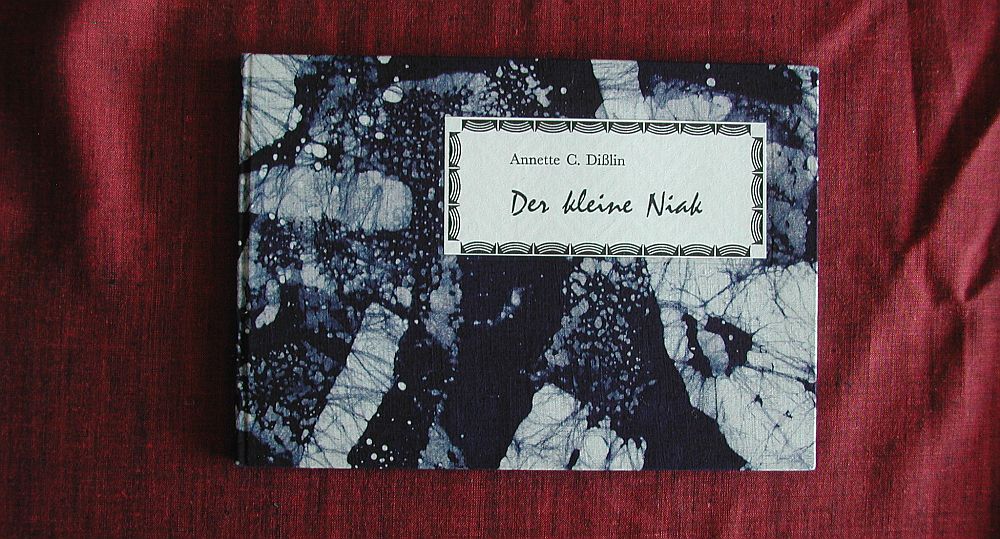
 

Little Niak - special edition

Little Niak – special edition

My very first book tells the the story of „Little Niak“. The book itself was published in 2001. However, the story is much older. I wrote it way back in 1986, when my goddaughter still was a little girl. The story was written to be read to her at bedtime.
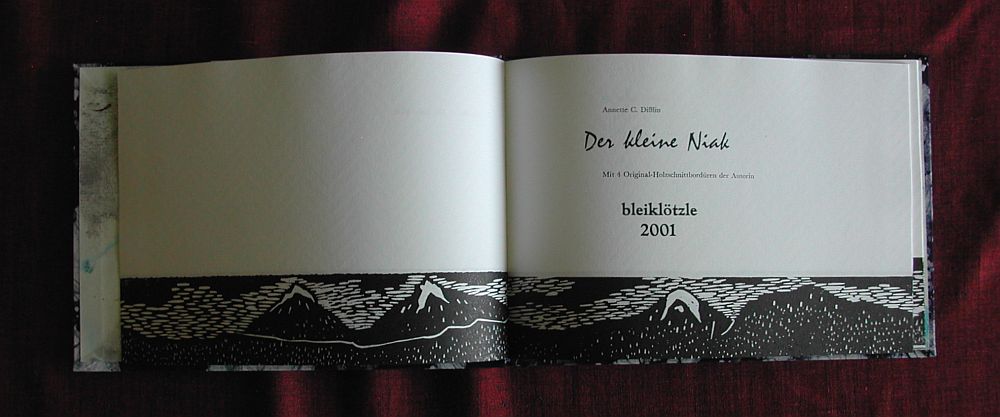
Little Niak - title page

Little Niak – title page

I had just got back from a trip to Sweden in summer 1986. We had been hiking in pretty remote places in Lapland. It was all far off any beaten tracks. In fact, it was far off any sort of track. We had been staying kind of in the middle of nowhere for some weeks. The scenery was stunning, to say the least. There was no kind of shelter apart from the tents we were carrying. It was a very special experience. When I got back there was this story in my head about a chap hiking in remote Lapland, exploring a cave while taking shelter from severe weather. In there he meets Niak and learns that this wee little guy is in charge of our weather. In fact, little Niak is the chef cooking our weather in his very special weather kitchen. So, after having delivered a heavy hail storm to the outside, the two guys sit by the fire, have a cup of tea and chat along about the recipes for snow and hail and the process of preparing the different sorts of weather for the different corners of this earth.
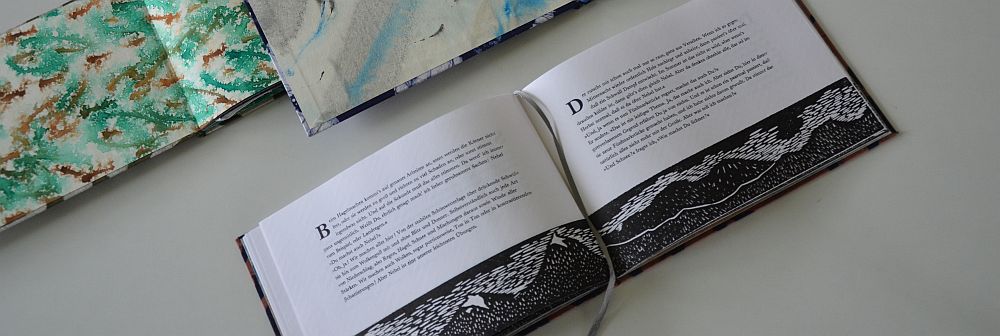
Little Niak - endpapers made from individually made decorated paper

Little Niak – endpapers made from individually made decorated paper

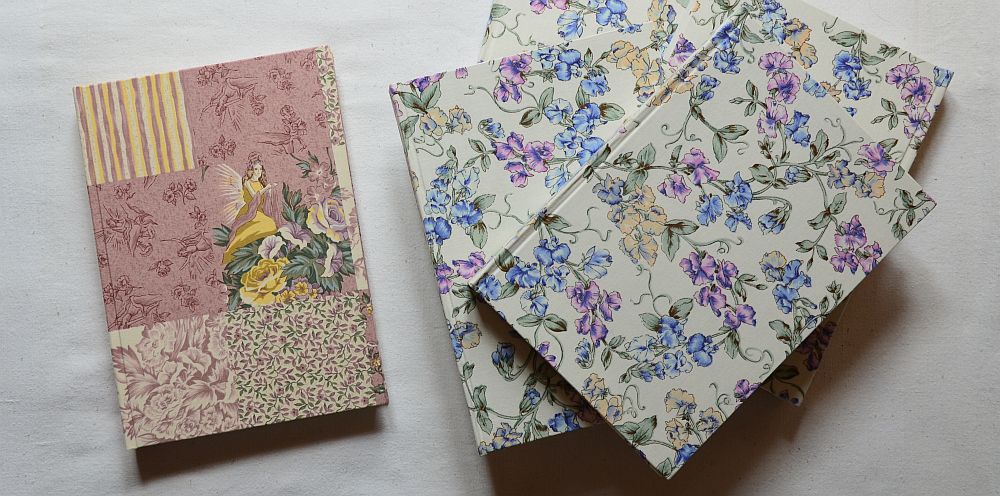
The book is a small size landscape format. I made 4 woodcuts showing the landscape of Swedish Lapland. The woodcuts run all along the bottom edge of all pages in the book and they run straight through the fold. The text is hand set from a fount of Baskerville we had cast ourselves on the Monotype machines at a colleague’s. It was an edition of ten copies and has sold out a couple of years ago. The covers of the special edition have been made from African hand batik fabric.
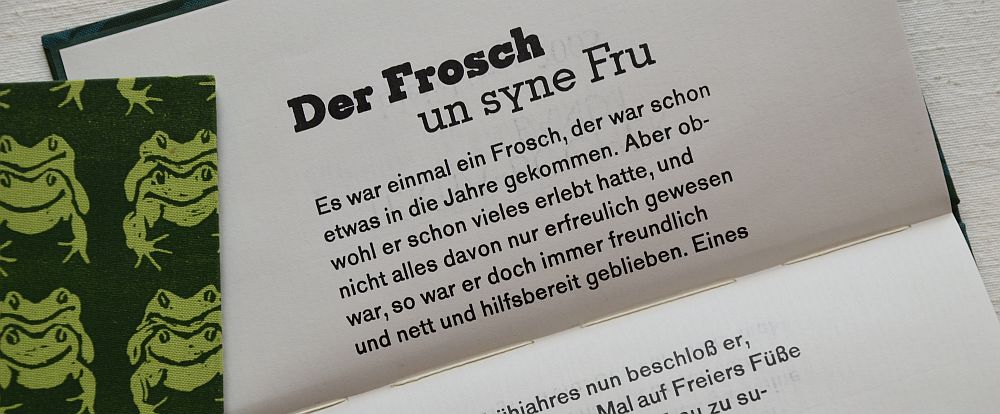
 

Der Frosch und seine Frau

Der Frosch un syne Fru

I have a pretty large number of books with fairy tales on my shelves. Many come from my aunt’s, who had been collecting books with fairy tales from all over the world almost all her life and left the books to me. I myself have grown up with the classics not only by the brothers Grimm but also by Anderson, Bechstein, Perrault and others. Then somebody suggested I might make a book about frogs. Instantly I had the idea of re-writing one of the Grimms‘ tales. One of their very classics is the tale of the fisherman and his wife. She is described as a voracious character, never satisfied. The book that grew from this idea is „The Frog and His Spouse“. It tells the story of an old frog who goes looking for a wife one last time and gets it all wrong. Being old and short sighted he chooses a warty toad who turns out to be insatiable.
The book is a small portrait format from outside, but landscape format inside and comes with two woodcuts. One is inside the book the other one is the cover itself, with the woodcut being printed on a bright green cover cloth. The text is hand set from Akzidenz Grotesk, Memphis is used for the headlines. I chose a paper with a nice decent waterline structure, somewhat resembling the small ripples on the surface of a lake touched by the wind. The book is an edition of 16 and was published in 2003. It is one of the last two books I made in the old place at Ebersbach, where I had started as a book artist originally. I moved out there only a few months after the book was finished.
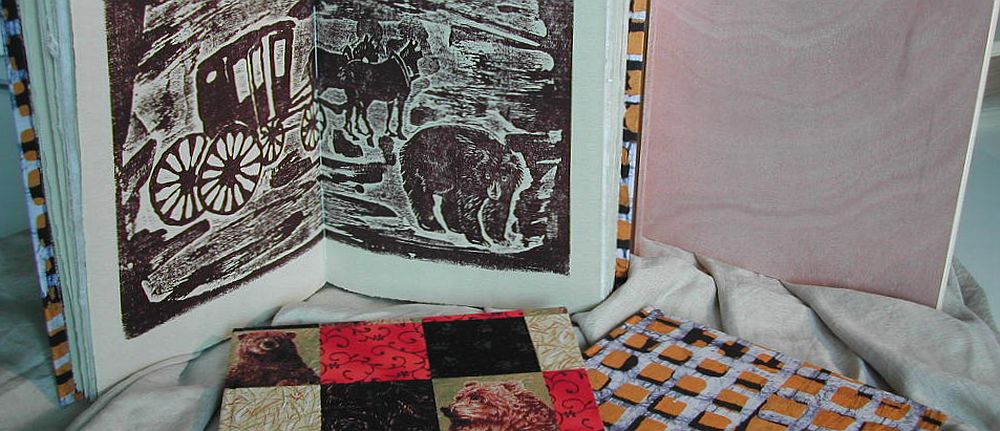
 

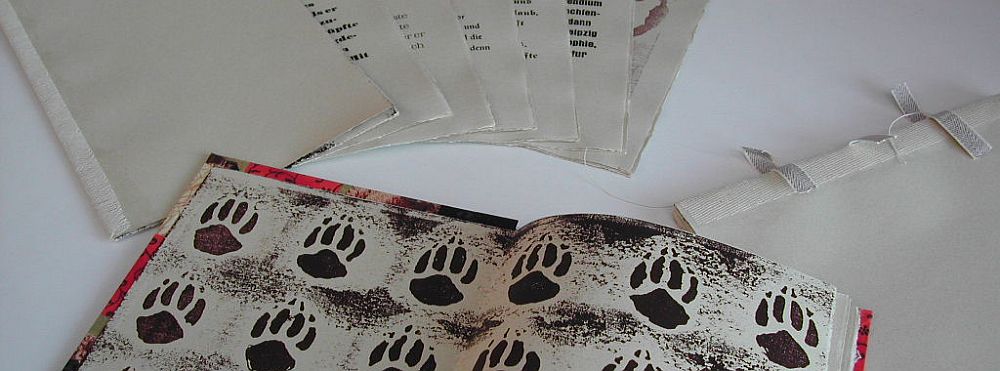
Das Nusszweiglein
Das Nusszweiglein

Das Nusszweiglein - endpaper and folded sheets

Das Nusszweiglein – endpaper and folded sheets

Ludwig Bechstein was a 19th century writer and librarian born in Weimar. He is known for collecting fairy tales and legends, his own writings are virtually forgotten. Like the brothers Grimm’s books his works have become classical compilations of long told tales and are part of many family libraries. In 2007 I decided to turn one of Bechstein’s tales into an artist’s book. I chose „Das Nusszweiglein“ (The Little Twig from the Nut Tree). The tale tells of a bargain, a curse and a transformation, and it is about confidence and trustfulness – and love.
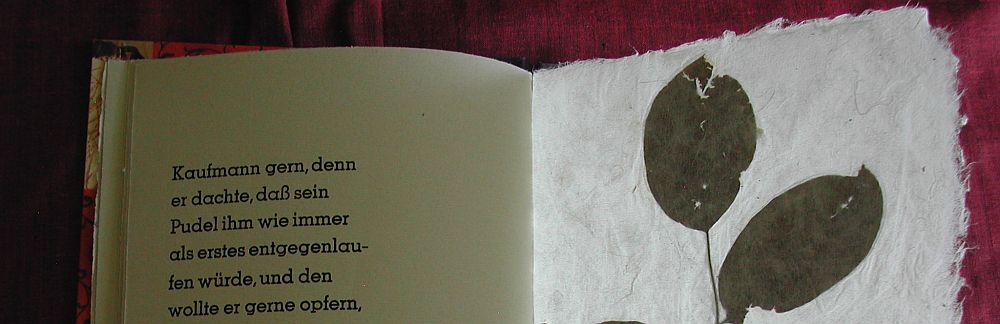
Walnut leaves embedded in silk paper

Walnut leaves embedded in silk paper

The book is printed on a green-grey deckled edge paper with wavey waterlines. I made five illustrations. They are lino etchings. One of them is a portrait of Ludwig Bechstein going with his biography. Each book comes with two walnut leaves embedded in silk paper. All text is hand set from a variety of metal type all of the same size of 20 pt. All founts are named in the back in the order of their appearance in the book. Founts used change from page to page. The standard edition is bound in a fabric with bear motif, in the special edition an African batik fabric was used for the cover. All books come in a wooden box. The book is an edition of 12, commemorating the 12 years our wonderful dog had been staying with us. She had passed away in 2006 aged almost 14.
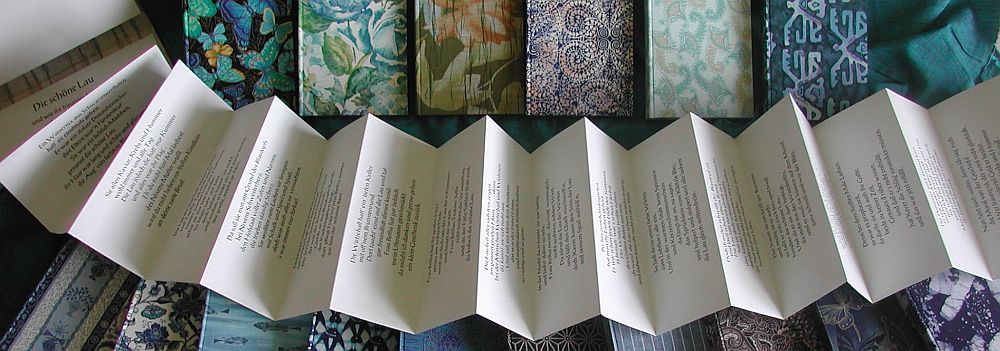


Die Schöne Lau - 16 unique blue covers

Die Schöne Lau – 16 unique blue covers

In 2009 my studio was 10 years old. The jubilee book was to be a special version of a very old tale. The story itself is very well known in Swabia, the region my studio was located.  It is part of a book written by Eduard Moerike, a 19th century poet and clergyman. The tale of „Beautiful Lau“ is about a water nymph being expelled by her husband for only having still born children. She has to overcome a curse by laughing five times, one time she is not allowed to become aware of it. A vital part in the tale plays a small piece of lead coming from a wizard and being full of witchcraft. There is a tongue twister about it that makes beautiful Lau laugh. The Swabian term for it is „Kloetzle Blei“ (little nugget of lead), which basically is the name I gave my studio. As for my studio it refers to the metal type I use for printing, each character being a little nugget of lead, that can work wonders when used in the right way.
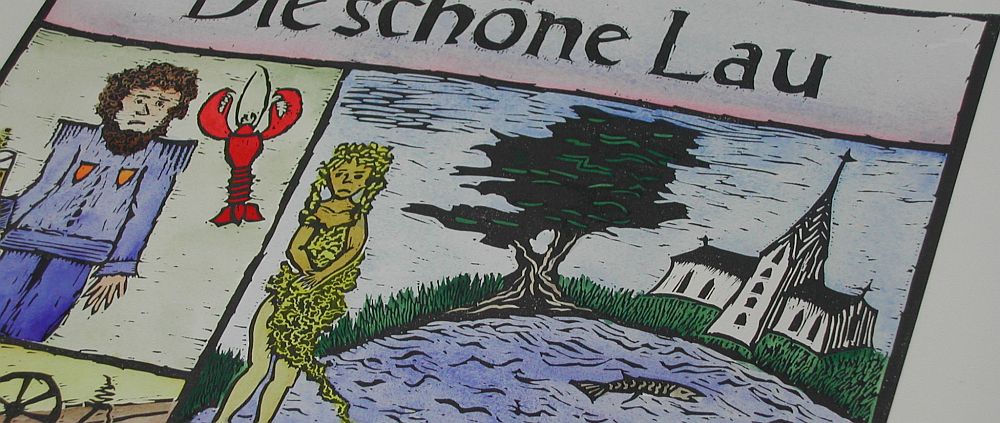
Die Schöne Lau - poster broadside

Die Schöne Lau – poster broadside

I transformed the tale of beautiful Lau into a broadside ballad. The book itself is a concertina folding. The tale adds up to a total of 19 stanzas. It is written to be sung with a very well known tune of an old ballad. During the jubilee event a ballad monger came with her hurdy gurdy and we performed the song in the classic way with me standing on a bench and pointing out with a stick the scenes on the poster broadside that is part of the work. The broadside is a linocut coloured by hand with water colours. The text in the book is printed on strong blue paper and the concertina is made in a way that it kind of pours out of the cover like a well flowing over. The book is an edition of 16.  All books have covers made from blue fabric, but every cover is unique. The special edition comes with a portfolio containing the poster broadside, a bamboo pointing stick, the poster announcing the jubilee plus one nugget of metal type with the number of the copy tied to the portfolio.  It is up to the owner to find out about the magic powers it might carry.
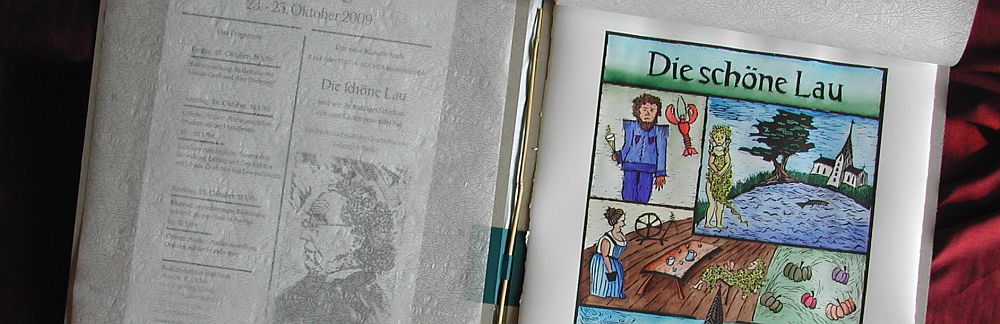
Die Schöne Lau - portfolio (part of the special edition)

Die Schöne Lau – portfolio (part of the special edition)


There was a scandal in 2009. It might not have grown into a scandal had it not happend during the silly season. Somebody had bought a pack of rocket and while unpacking it he had found some herb of the wrong sort. He could have chosen to just sort it out and throw it away.  But he did not so. He sent it to a laboratory and it was identified as being a poisonous plant, and that was, where the scandal took of.  It resulted in a number of very specialised gardeners‘ businesses almost going broke as people virtually stopped buying rocket.  The herb found has an appaling taste. Normally you would just not eat it.
Rucola

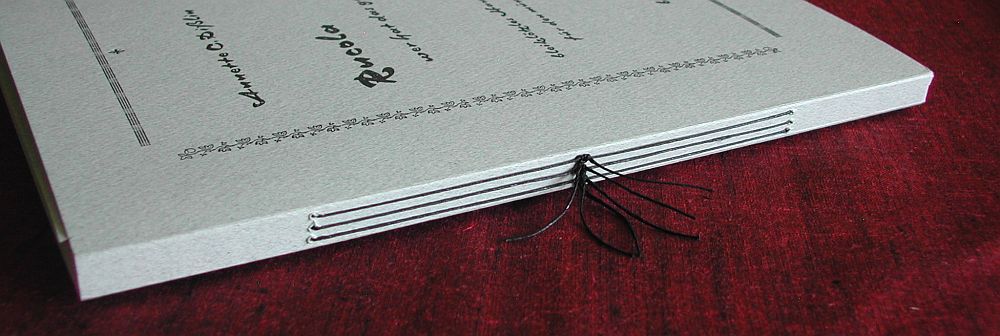
Rucola

The book inspired by this incident was „Rocket – who has found this?“ and it was published in 2010. It describes 21 plants in text and images that could be mistaken for rocket – well, more or less. The illustrations are linocuts showing the outlines of the leaves. On the bottom of the page describing the respective plants there is a scale showing whether the plant can be eaten or is considered poisenous. There is a sachet pasted to the inside back cover containing dried rocket leaves. The book is sewn through the back with black thread.
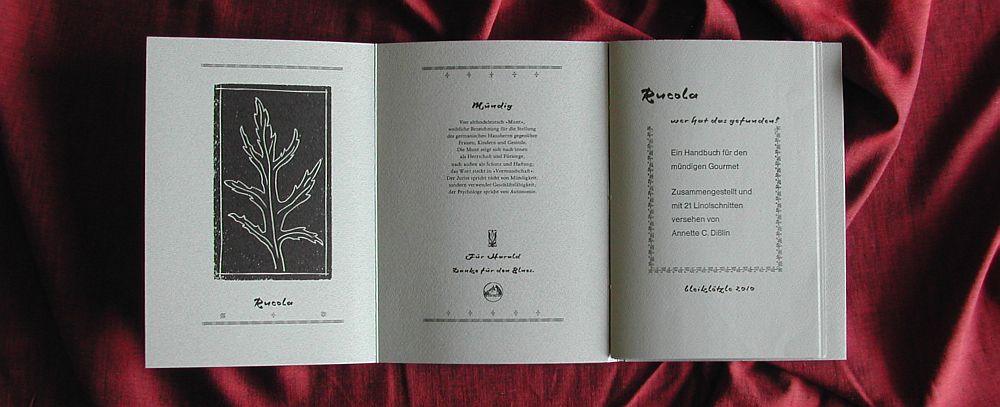
Rucola - title page

Rucola – title page

The book is all about taking responsibility for oneself, for ones own health and life and for the risks one decides to take. It comes with a quote of Immanuel Kant’s quintessential proposition based on the old Latin advice „sapere aude!“. There is a standard edition of 15 copies (Arabic numbers), and a special edition of ten copies (Roman numbers), the latter coming with a poster with all 21 linocuts.  Being a trained botanist I thoroughly enjoyed making this book. It is dedicated to our late friend and talented Blues musician Harald Goldhahn who died far too young just before Christmas in 2009, the very time when this book was in the making.
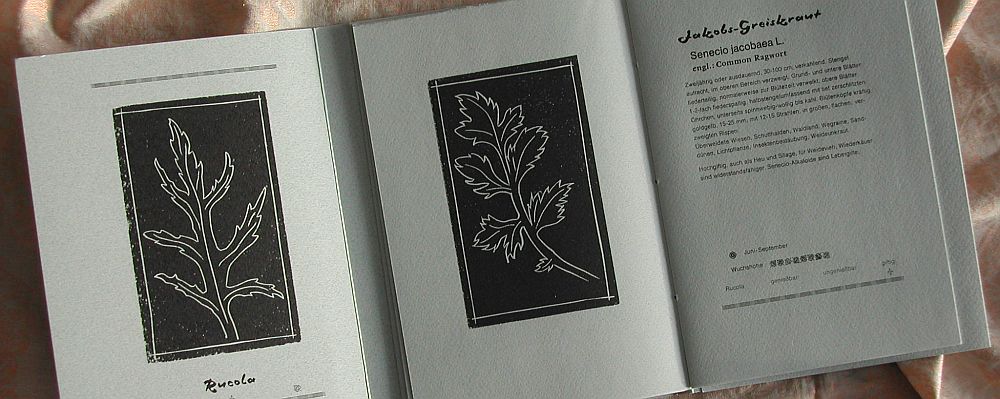
Rucola

Rucola


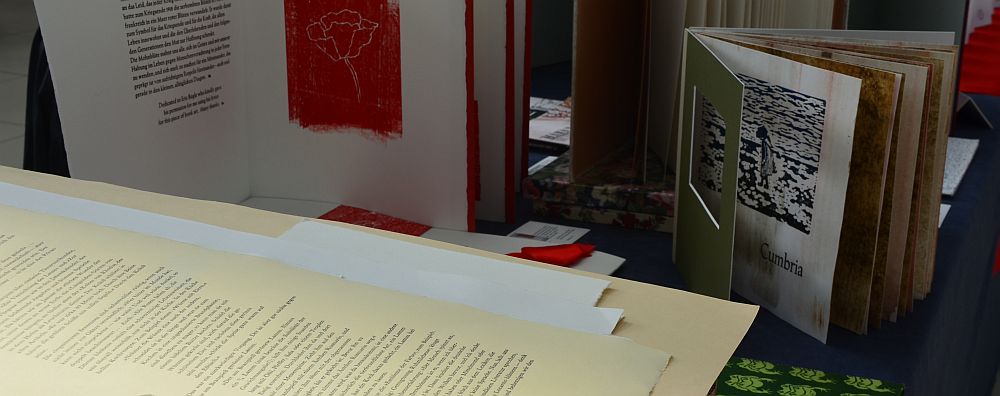
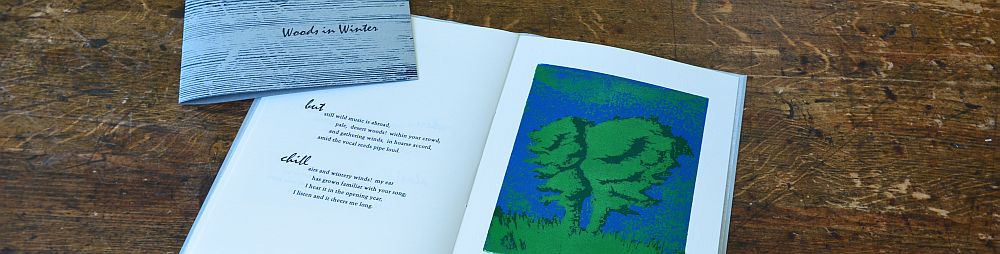
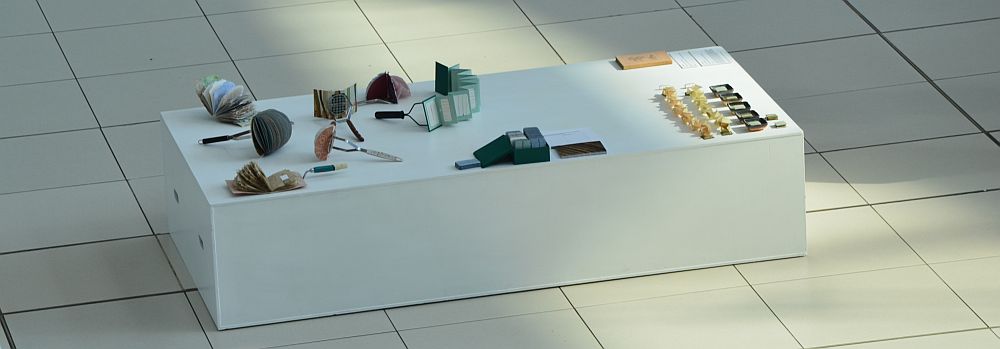
So far I have made two more illustrated books. One is „Cumbria“ (Image on top of this post) and the other one „Woods in Winter“ (image below). Both books are completely in English and will be part of an extra blogpost covering those of my works that have a British background. So stay tuned, there is more to come.
woods-in-winter

Fairs I’ve been part of so far


Turn The Page 2013, Norwich (UK)

Turn The Page 2013, Norwich (UK)

For the time being I am stuck in the middle of the process of relocating. As a first step I have moved away from my studio to live in Westfalia, and find myself now separated from my workplace for an indefinite period of time. This seems to be the perfect moment to look back and recall how things have evolved. This particular post is all about the fairs I have been part of so far. It is not about all the fairs I’ve been to, as you can  imagine, but about many of them. You might find it somewhat odd that from 2012 onwards I have not attended as much fairs as before. This is nothing to do with the respective fairs. This is for the simple reason of a lack of time due to the relocating process waving its flag from afar at me for quite a while already.


Turn The Page in Norwich (UK)

Turn The Page 2013, Norwich (UK)

Turn The Page 2013, Norwich (UK)

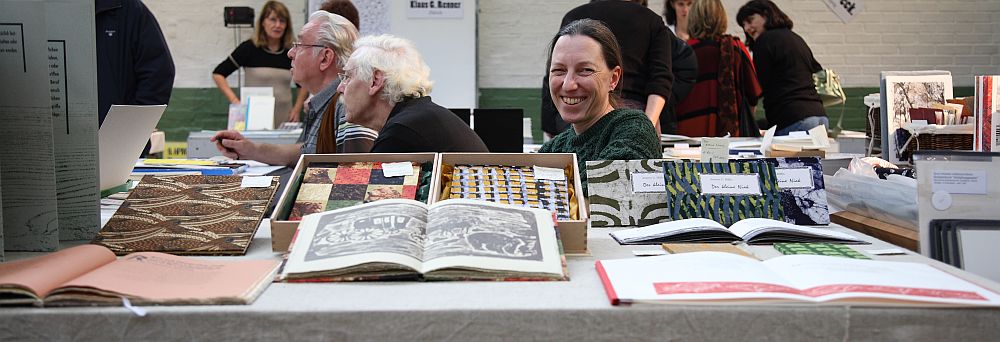
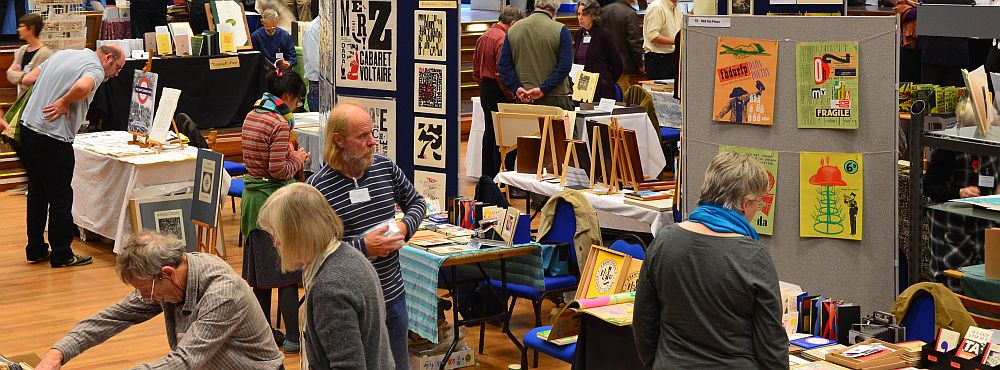
In 2014 and 2013 I had been admitted to exhibit at Turn The Page artists‘ book fair in Norwich. The fair is held in the glass roofed entrance hall of The Forum each year in early May. The impressive building also houses the public library, the Tourist Information, a café, and on the upper floor an Italian restaurant, plus the rooms of the BBC. It is a vibrant meeting point right in the city’s centre. Just across the street is the Market with its colourful stalls offering almost everything from baked potatoes to second hand clothing. To the left and across the street there is the old Guild Hall. It is a fascinating piece of flush work craftsmanship and houses a Caley’s Cocoa Café. It is the country’s largest civic medieval building outside London. The Forum, on the contrary, has been built on the turn from the 20th to the 21st century, on the site where the old library had burnt down in 1994. The entrance hall is a wonderful venue for this book fair. Each year a jury admitts some 35 artists to showcase their work. Exhibitors might come from as far as the US. There is a blogpost here to be found in the „Fairs and Markets“ category telling what the 2013 fair was like.


Norddeutsche Handpressenmesse in Hamburg

Norddeutsche Handpressenmesse 2013, Hamburg

Norddeutsche Handpressenmesse 2013, Hamburg

So far I have been part of the artist’s book fair in Hamburg three times, in 2009, 2011 and 2013. The fair used to be biennial but in 2013 changed into an annual event. Exhibitors are admitted by lot – so participating is a question of good luck. But with the fair now being every year many more book artists will be able to consider themselves lucky over the years. The „Norddeutsche Handpressenmesse“ is housed in what is called the „Museum der Arbeit“. The impressive old red brick building was turned into a museum several years ago. It houses a rich collection of printing presses, metal type and equipment for type casting.  All of which is shown working by passionate and thouroughly trained volunteers to the visitors during fair times.  For this fair, too, you’ll find a separate blogpost from 2013 in the „Fairs and Markets“ category.


Leipzig Book Fair

Leipzig Book Fair 2008

Leipzig Book Fair 2008

Leipzig has a long bookish tradition. For centuries it was home to book fairs. And nowadays with each book fair there is a more than rich programme of readings and performances in all sorts of venues throughout the city and its outskirts.  In 2008 I went there as a first time exhibitor. I presented my then new book: „Das Nusszweiglein“, a fairy tale by Ludwig Bechstein. Another new artwork I put on show there was the scriptural series „Soil Letters“. This series was inspired by Chinese calligraphy. I had taken up lessons with a Chinese teacher some time before and working with the brush in this specific way just mesmerised me. I had printed a broad side using Matthias Claudius‘ poem „Song of War“. After completing the print I went over it with the brush and dye prepared from soil pigments, to give it the shades of earth and blood that go with the text. Alongside grew the idea of having the series of „Soil Letters“.

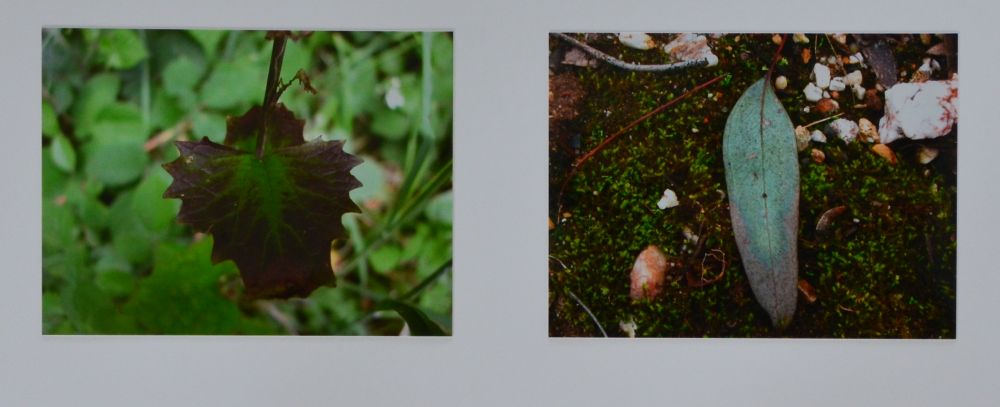
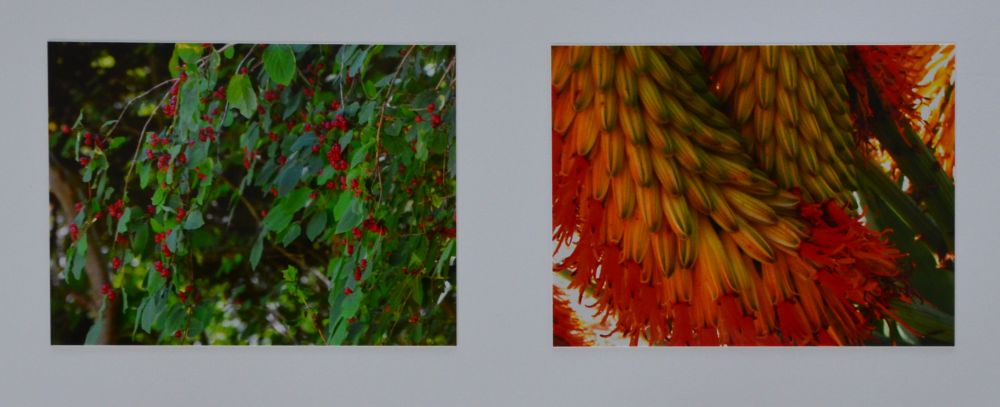
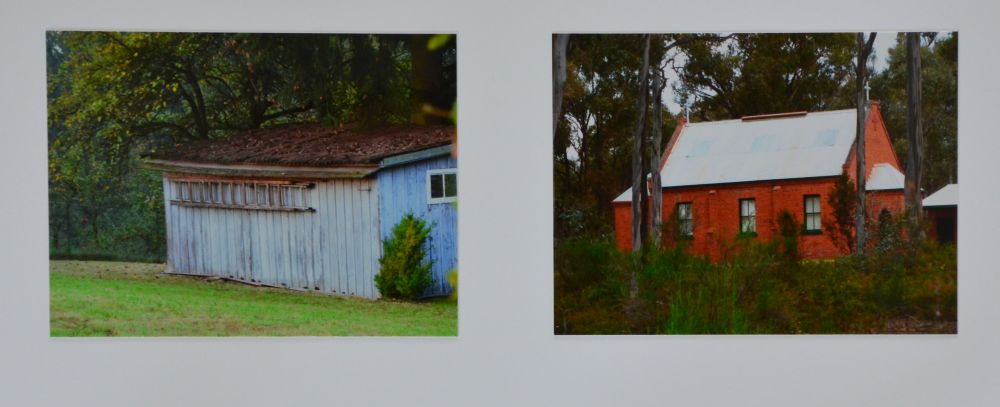
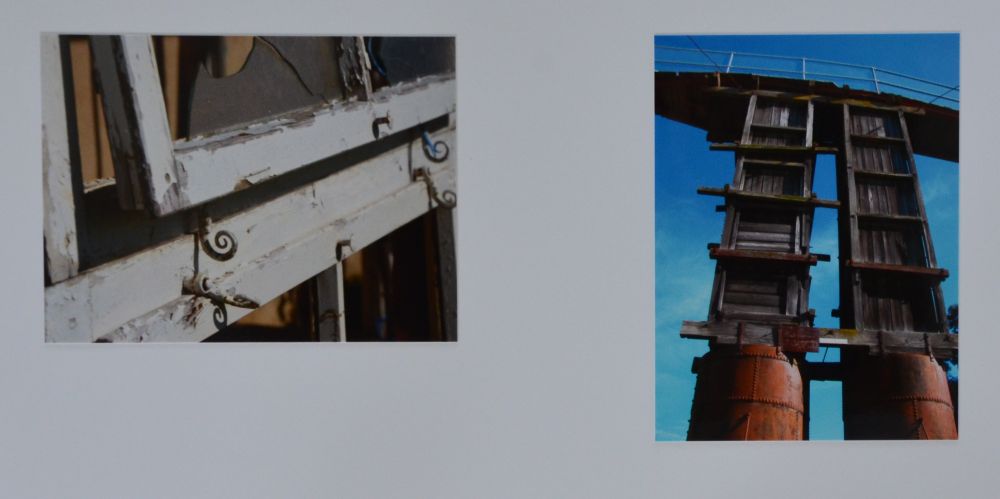
I went to Leipzig Bookfair for a second time in 2014, presenting my new book „52 Weeks“. It is a collaboration with Australian artist Marianne Midelburg and my first artist’s book using photos. For both, the book „52 Weeks“ and Leipzig Book Fair you can find specific posts on this blog in the „Photobooks“ and the „Fairs and Markets“ category respectively, and you’ll also find a 2014 post on „Marktplatz Druckgrafik“ the young venue for printmaking artists within Leipzig Book Fair.


Mainzer Minipressenmesse (International Fair for Small Presses and Publishers, Mainz)

Minipressenmesse 2011, Mainz

Minipressenmesse 2011, Mainz

The first artist’s book I ever made was „Little Niak“ (Der Kleine Niak). It was out in 2001, just in time to be presented at Mainzer Minipressenmesse. This international fair for small presses in Gutenberg’s hometown Mainz is a very special event. It has a long tradition. It is held every other year (the odd numbers) and until 2011 the venue was housed in two large tents right next to the banks of river Rhine. In 2013 the organizers gave the schedule a slight brush-over. The event is now a few weeks later, in June, plus it moved from the tents into Rheingold Hall, which is only a few yards further into town. The tents are being sadly missed by some exhibitors for their make-shift character, which certainly was special. However, there have been years when there was a serious risk of flooding from the nearby river. And there have been severe thunderstorms which have not been very pleasant to sit out in just a tent, even a big one. So with the fair being indoors now both, exhibitors and visitors can get their heads down on the books and prints and publications without keeping one eye glued to the floor in case water comes rushing in.
I have been showcasing my work here on quite a regular basis until 2011.


Druck & Buch, Erlangen (Print & Book, Erlangen)

Druck & Buch 2009, Erlangen

erlangen-poetenfest

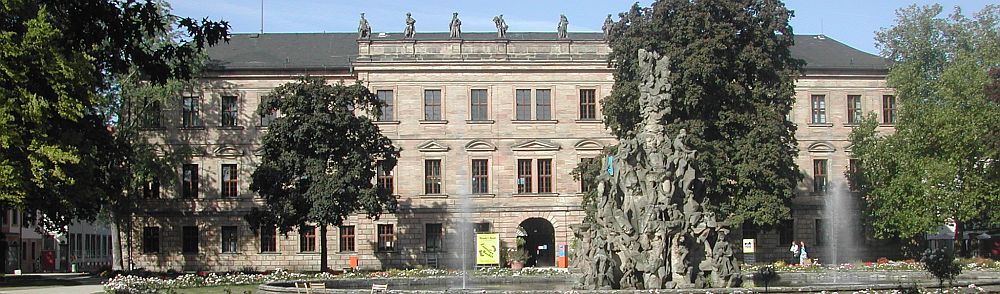
Every year in late August Erlangen invites people who love reading to come to their traditional „Poets‘ Festival“ (Poetenfest).  The event comes with a rich programme of readings and performances. It is considered to give the opportunity for something like a „sneak pre-listen“ to some of the new and upcoming titles in autumn. One of the venues for the readings is the huge castle right in the city centre. The photo above shows the castle’s front facing the park which, too, is a venue for readings, with people sitting under the large trrees outdoors. During the final weekend of the Poets‘ Festival the entrance hall of the castle houses a fair for artist’s books called „Print & Book“ (Druck & Buch). As it is not a big space only some 24 exhibitors will be able to show their works. I have been part of this event from 2009 to 2012.


Künstlerbuchmesse Klaffenbach (Artists‘ Book Fair in Klaffenbach)

Artist's Book Fair at Castle Klaffenbach 2010, Chemnitz

Künstlerbuchmesse auf Schloß Klaffenbach 2010, Chemnitz

Just outside the city of Chemnitz there is a beautiful moarted castle. Castle Klaffenbach houses an artists‘ book fair. The old castle is a very nice venue with a lot of carefully restored, charming rooms where books and prints can be shown to the visitors in a very special atmosphere. With each fair there is an award given to one artist chosen by a jury, the Von-Taube award. I have been at Klaffenbach in 2010 and 2012.


Frankfurt Book Fair

Frankfurt Book Fair 2010

Frankfurt Book Fair 2010

Frankfurt Book Fair used to have the „Place of Book Art“ (Platz der Buchkunst) for a period of 10 years, but sadly gave up on doing so just the very year I went there as an exhibitor. This was back in 2010. I was presenting my brand new artist’s book on Kurt Tucholsky there. Tucholsky had taken his own life exactly 75 years earlier, in 1935. You can find more on this artist’s book in a 2013 blogpost in the „Miscellaneous“ category, when there was an article on this book in „Matrix 32“.


Frauenfelder Buch- und Handpressenmesse, CH (Frauenfeld Book and Fine Press Fair, CH)

Frauenfeld Fine Press Book Fair 2008, Switzerland

Frauenfelder Handpressenmesse 2008, Switzerland

Frauenfeld Fine Press Book Fair 2008, Switzerland

Frauenfelder Handpressenmesse 2008, Switzerland

In autumn 2008 I went to the book fair in Frauenfeld, Switzerland. This, too, is a biennial fair (in the even numbered years) organized by Atelier Bodoni. The town of Frauenfeld is not far from the German-Swiss border. The fair is called Frauenfeld Book and Fine Press Fair (Frauenfelder Buch- und Handpressenmesse). It is in quite a special venue: an old ironworks with a very specific flair. This was my first ever fair abroad.

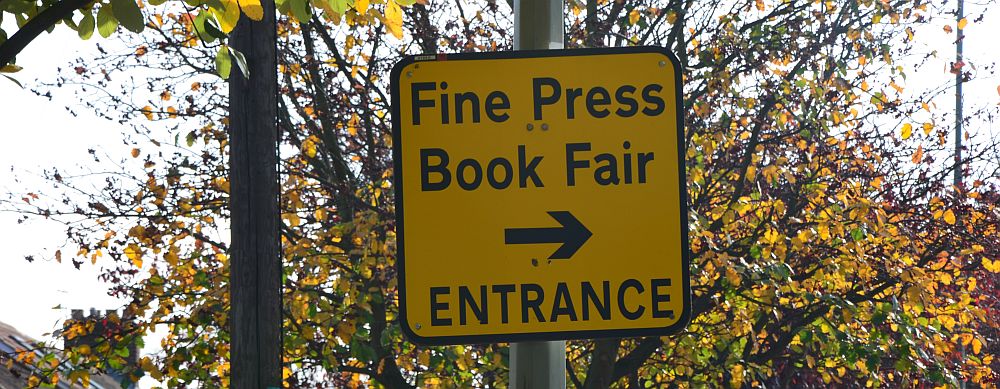
In late October I shall be exhibiting at the Fine Press Book Fair in Oxford. In 2011 I had been a visitor there.  Save the date – it is very much worth while going there. And if you can spare a few days more, stay on and pay a visit to the city’s many treasures, such as the Bodleian Library.

Fine Press Book Fair 2011, Oxford (UK)

Fine Press Book Fair 2011, Oxford (UK)

OxfordFinePressBookFair2015-q


My Workplace 2004-2015


Korrex Hannover

Korrex Hannover

The place where I have been working all those past eleven years is currently in a sleeper mode. It sits in waiting for me to come and get all the presses, the type racks and type, the paper stock, the bookbinding presses, tables, tools, ink tins, brushes, jars of pigments and all the odds & ends that make up a book artist’s workplace. I’ve got to be patient. We need to find a new place to fit everything in fit for working. So this seems to be the perfect moment to look back thinking of what it was like to move in here and work here on a daily basis, designing art work, cutting blocks, setting type, printing sheets, binding books.

52 Weeks -  Photo-Artist's-Book in collaboration with Marianne Midelburg (AUS)

52 Weeks – Photo-Artist’s-Book in collaboration with Marianne Midelburg (AUS)

I moved in here in February 2004. Back then everything was new and dusty and the walls were bare. We set out to paint them white. I cannot recall just how many buckets of wall paint we ended up needing. Again and again we went to get another one or two. We were lucky in that there was hardly any snow that winter once we started moving press & type. With the help of dozens of friends we managed to have all in place right in time before the opening in March. Our late friend Harald Goldhahn (Harry Hirsch he called himself) came to play us his wonderful Blues. In the previous year he’d asked me to print the sheets for the booklet for his new CD „God Moves on the Water“. Visitors were squeezing in. The whole place was buzzing with life and Harry’s songs until after midnight.

Booklet and CD "God Moves on the Water"

Booklet and CD „God Moves on the Water“


The artist at her press

The artist at her press

I had bought my first proofing press back in 1998. It is a 1956 Korrex „Hannover Hand“ with a printing size of 50 x 70 cms; all hand operated, cylinder as well as rollers. The rollers were a bit worn and one of the spindles was slightly bent. For years I could not afford to have them fixed, so until far into 2006 all inking had to be done by using hand rollers.

Tita (1992-2006)

Tita (1992-2006)

Two years after I had moved in we had to say Farewell to our good old dog Tita aged 14. She had been a true and brave companion for more than 12 years. When we went to collect metal type from somewhere, she’d guard the cases piled up in the van by making herself comfortable right on top of the pile. And she’d look all impressive up there.

Metal type: Unger

Metal type: Unger

Alphabet card: Unger

Alphabet card: Unger

Over the years the stock of founts grew. I had started off with one case of Victor Hammer’s Uncial. By now I can choose from some 100 founts of metal or wood type. There is a good choice of ornaments, too. In 2012 I decided to print all my founts as alphabets on cards. It took far longer than expected.

Ornaments

Ornaments

Ornaments: Christmas

Ornaments: Christmas

The type came from all sorts of places: printing offices that had kept it but now needed the space for new machinery, trained composers who had saved some type on retirement, schools giving up on printing. Each and all of the cases came with their own story.

Tools and add-ons

Tools and add-ons

composing-tools

Some came with the most fascinating of tools, with a handful of composing sticks and awls, or with a pile of old tins with ink. Basically, half of the place is filled with presses and type racks, including three platen presses, one of which is an Adana 8×5.

Adana

Adana

prints-drying

Prints can be hung up for drying or left in a metal drying rack. In 2010 a second proofing press completed the team. This one is a mid-1960s Grafix press, its cylinder still hand operated but the rollers motorised. It is slightly smaller in printing size but very smart to work with.

Grafix proofing press

Grafix proofing press


Woodblock

Woodblock

Linocutting

Linocutting

The rest of the studio houses the area for cutting blocks from lino or wood, the paper stock and all that is needed for binding books.

Bookbinding

Bookbinding

Board shear

Board shear

I had been luckky to find an affordable board shear in 1999. It might be the eldest tool in the studio being over 100 years of age. It is somewhat special in that it is fitted with a wooden worktable. I have been to a number of bookbinding workshops, basically between 1998 and 2005. I learned a variety of techniques including how to prepare inks and dyes.

Bindings

Experimenting with Binding Techniques

Calligraphy

Calligraphy

For a few years I was given the opportunity to learn Chinese Calligraphy from a Chinese teacher, until she left for going back to China. I consider myself extremely lucky for this wonderful chance to widen my horizon.

brushes

Repeatedly I have used my own dyes prepared from soil pigments to paint sheets prior to printing for both books and broad sides.

from the series "Soil Letters"

from the series „Soil Letters“

Since the late 1970s I have been into photography. I got started with some very simple camera, at one point was given my parents‘ old Contaflex with a separate photometer, and finally had my own Nikon FM camera. I have changed over to a digital one a couple of years ago.

Contaflex and photometer

Contaflex and photometer

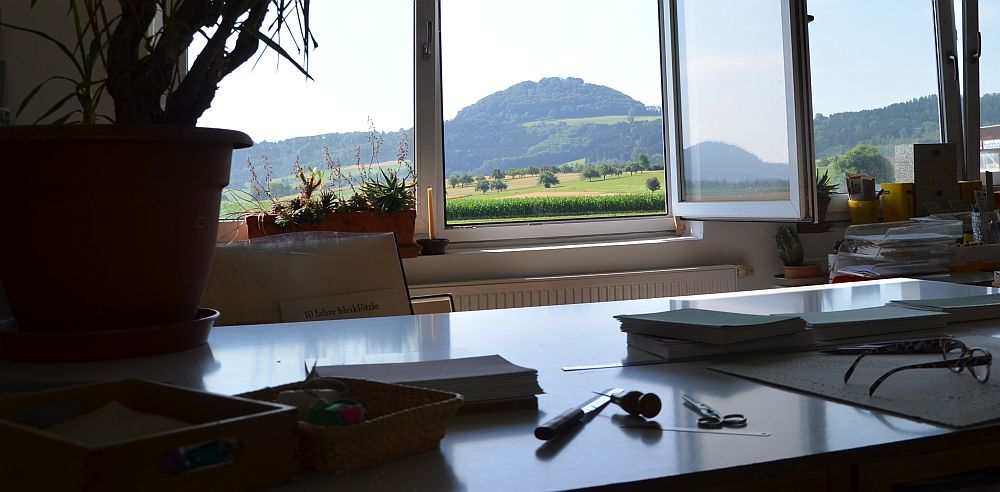
Over the past eleven years I haven been making quite a number of prints and books here. There have been Open-Studio events at least on a once-a-year basis, often one in summer and one in winter. Many people have come and seen the place. Some have taken the chance to have a go at the old proofing press and print a sheet with their own hands feeling the wheel and cylinder move. Some came and gave me their last case of metal type, covered in sheets of dust from having been down in the basement for decades untouched. Some have told me the stories of their working lives in printing offices. I have had a stunning scenery lying just beyond my studio’s windows. Almost everybody was blown away by it when visiting me. Next step for me will be to get the studio ready for shipping once we found a new place fit for working in.
(Plans to enlarge the industrial area haven been more or less approved, so there will be substantial changes to the scenery here in the near future.)

July 2012 - outside the studio's windows

July 2012 – outside the studio’s windows


Working Visit + Fairs to Come


Working visit

Working visit

We’ve still not found a suitable place to put all my printing and bookbinding gear in. Commissions started coming in. There’ll be fairs to go to from early September onwards; good reasons for a working visit in my studio. On July 8th I was headed south.

Hohenstaufen from the workplace

Hohenstaufen from the workplace

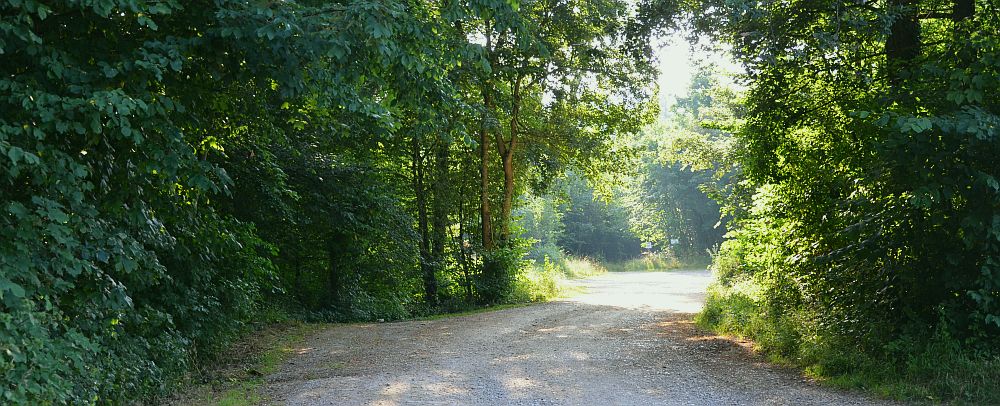
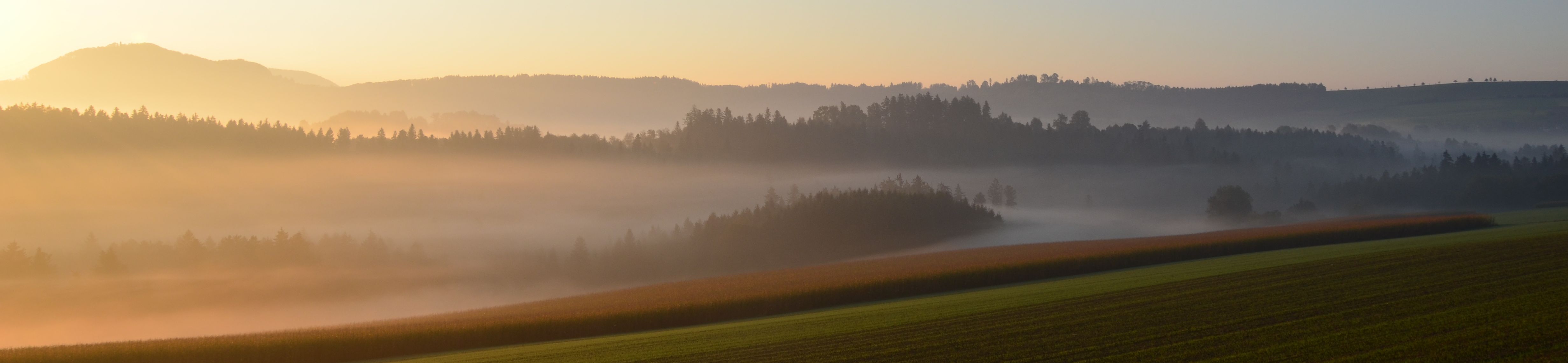
I was back at my old place after a six hours drive over summerly motorways and after having been away for almost three months. I realised, once more, what I loved this place for. It is quiet here. Friday morning was crisp and cold. I went for an early morning walk through the forest on a path well known. It was where we used to walk our dog. The old lady preferred the woods for her daily walks. She has long left us and the forest has grown dense over the years.

Forest near Wäscherschloss in summer

Forest near Wäscherschloss in summer


Pond with reed

Summerly rapeseed field

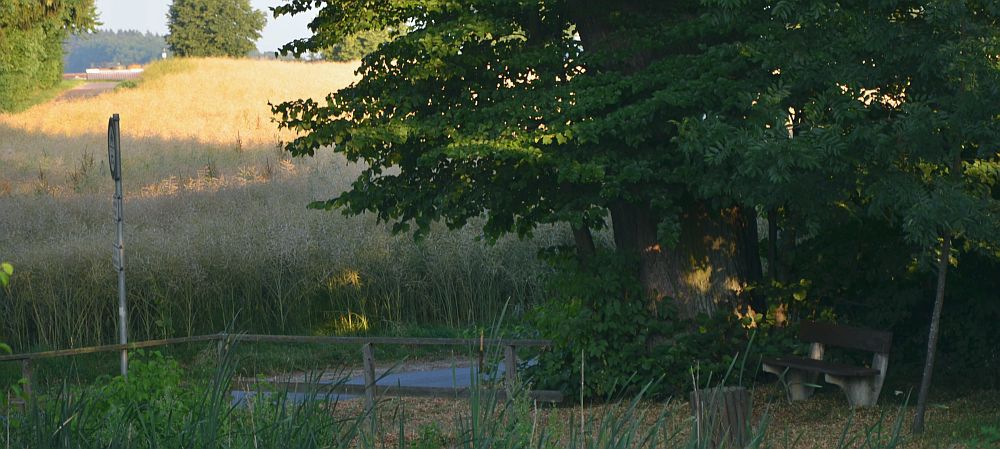
Just opposite the room where I was staying is a pond which is meant to be a reservoir of water in the case of a fire in the small hamlet. This pond is overgrown with reed and seemed to be filled with crickets. Their chirr filled the late hours before midnight. But in the end they might have been chirping in that field of rapeseed which, further back, was waiting for being harvested.


House mouse visitor 2013

House mouse visitor 2013

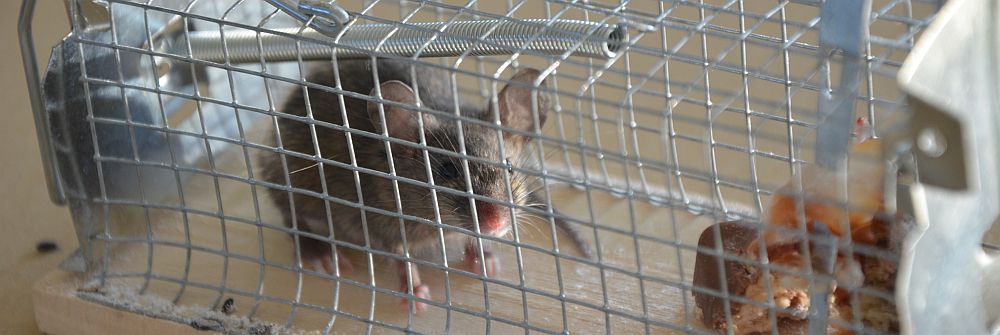
It was a great relief that I could not find any signs of uninvited visitors. Over the past two years mice had invited themselves in on a few occasions. They must have wandered in through the open door and decided to make themselves at home. It was house mice in 2013 and shrews in 2014. The house mice came in a group of three and turned out to be tricky to catch. The shrews came one after the other and were surprisingly cooperative. I caught them all alive and gave them a lift to some nicer place outside – far enough away from my deckled edge papers and handmade books.

However, it came as a surprise when I actually watched a sparrow flying into the studio through the open window. The little lad seemd to like the place (well, I don’t blame it) and it took me half of Friday and half of Saturday to persuade it, to go and play with its mates outdoors again.

working-folding-sheets

Folding sheets

Folded sheets

Folded sheets

working-bookblock

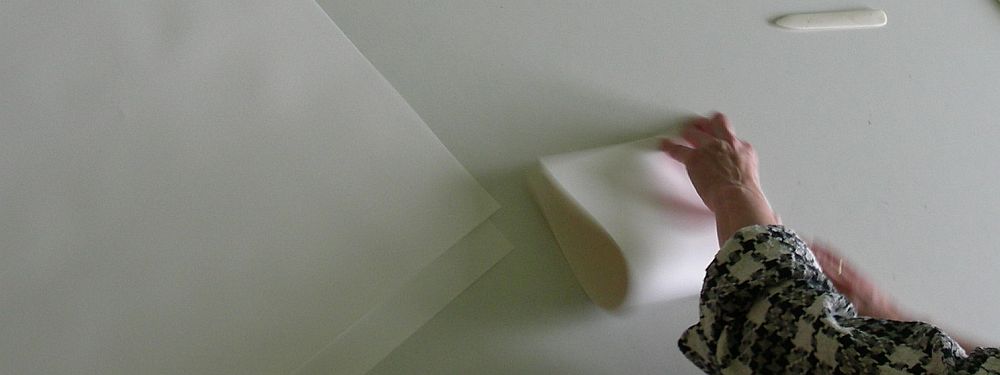
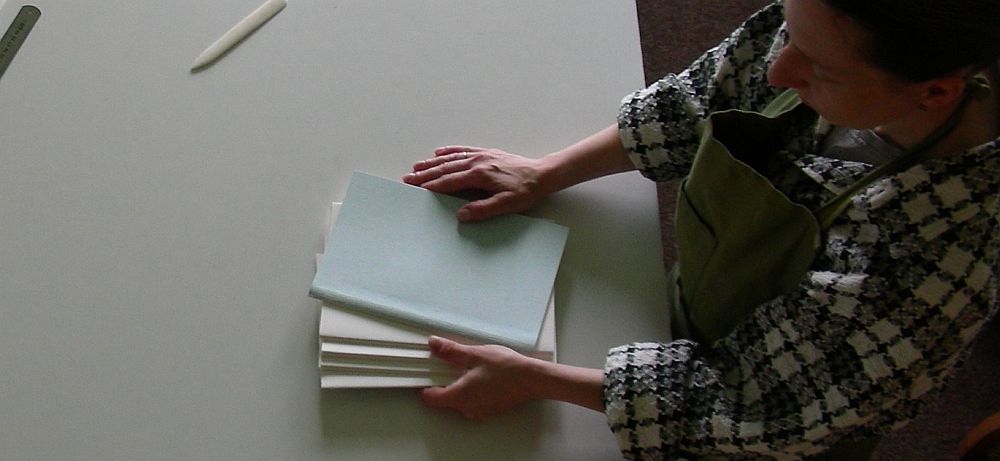
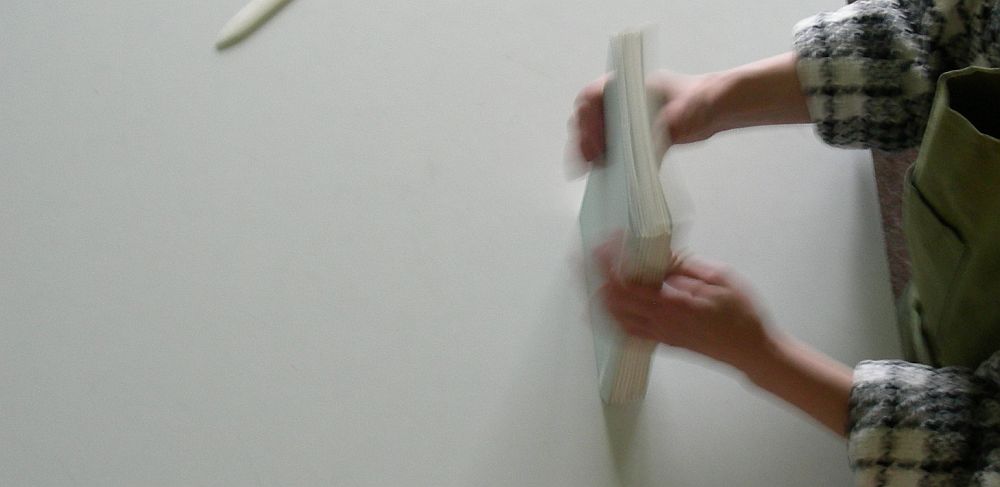
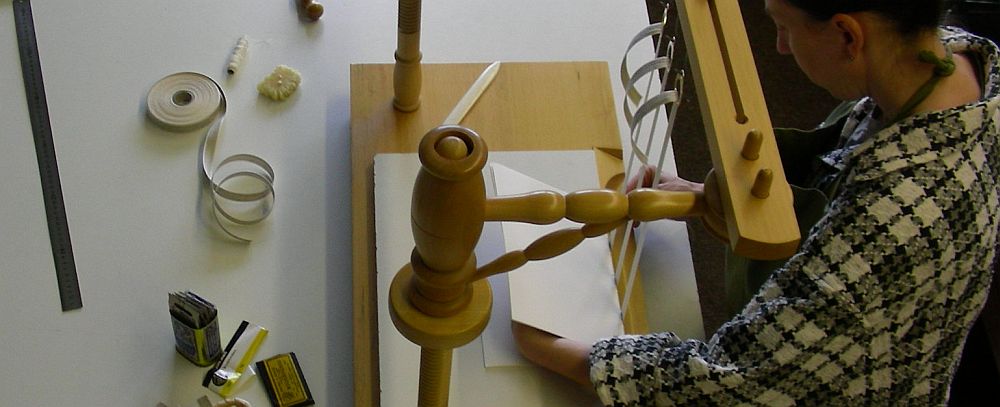
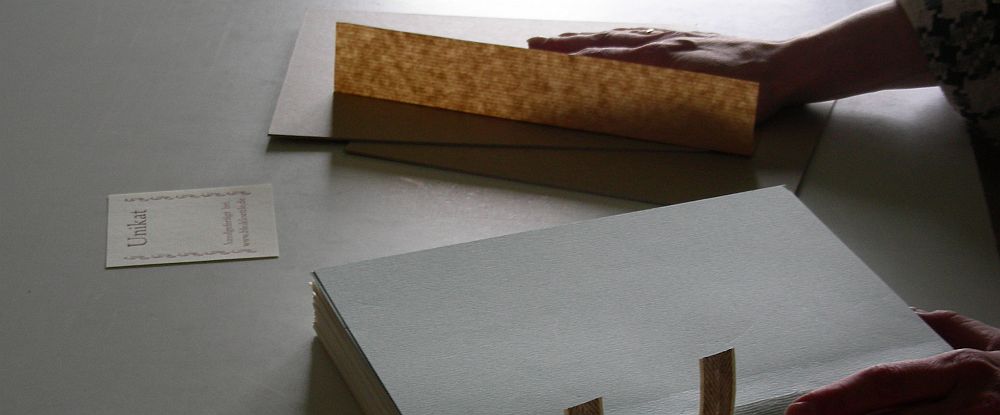
Working this time meant making books to order. Cutting, folding and sewing sheets. Making covers from fabric and have nice books in the end. My customers wished for books to write into, so it was all blank sheets.

Sewing book

Sewing book

working-assembling-book


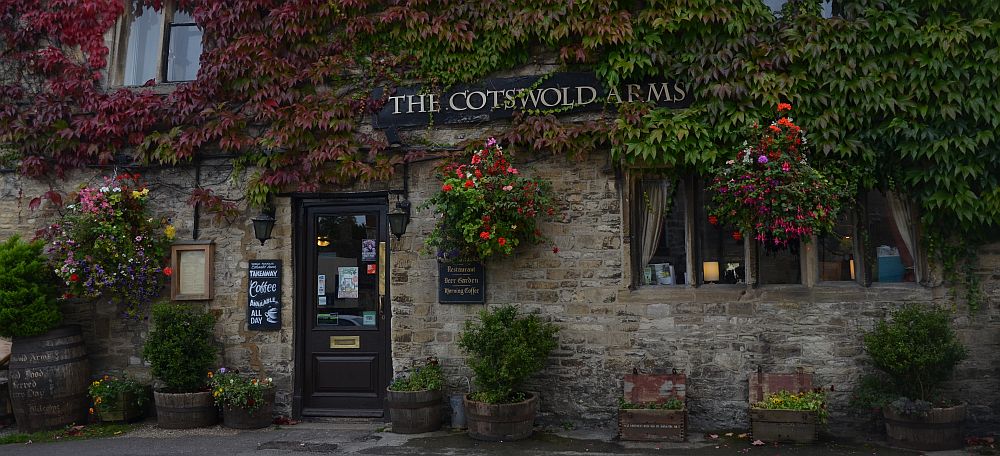
The Cotswolds Arms

The Cotswolds Arms

Working also meant packing up artist’s books and prints to have them at hand once it comes to travel to the fairs coming up in autumn. Three dates are fixed. It shall be ferry time twice this year, going from Hoek van Holland to Harwich port again. To start with I’ll be part of Whittington Day at Whittington Press near Cheltenham (UK) on September 5th. We’ll be staying on a couple of days enjoying autumn in the Cotswolds. Last year lucky us two picked what later was said to be the warmest September on record. That was not what we came for, but we enjoyed it all the same.

The Fine Press Book Fair at Brookes University, Oxford (UK)

The Fine Press Book Fair at Brookes University, Oxford (UK)

A couple of weeks later I shall be part of the Fine Press Book Fair at Oxford’s Brookes University. The fair will be open on 31 October and 1 November. We’ll be staying on a few days again, greeting Oxford with its Bodleian Library, its gargoyles, its bookshops, the Covered Market and its coffee houses.

Bookshop Oxford

Bookshop Oxford

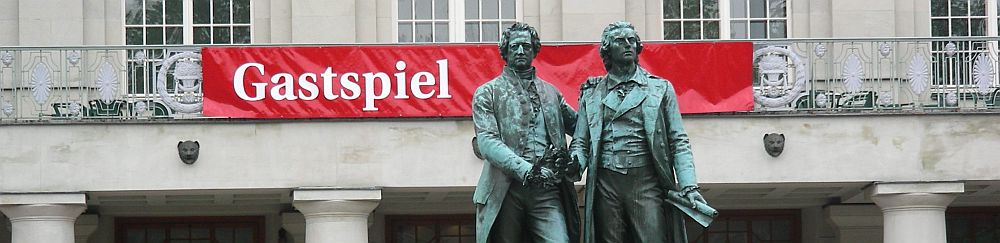
The next fair to come is 5th Book Arts in Weimar on 28 and 29 November. So after having had a rather long period of more than six months with no fairs at all there’ll be a few of them in quite short a period of time.

Weimar: Goethe and Schiller

Weimar: Goethe and Schiller

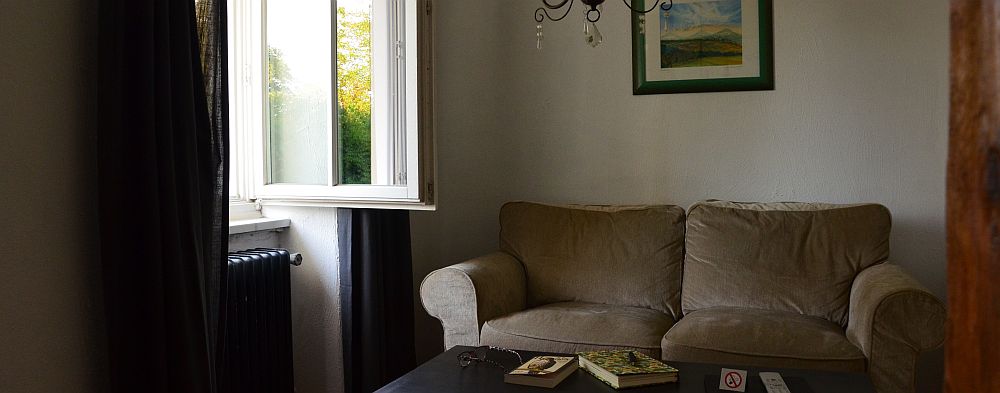
By Sunday morning all new books were finished and all the boxes with artist’s books and prints were safely piled up and secured in my little van. I hit the road on Sunday 12th July around 9am. It was still warm in the south. The farther north I came the cooler it got and after some 350 kilometres the downpours began. I made it back in good time.
studio-working-visit-books

Mission accomplished

As I write this it is still overcast, we did have more downpours and all the herbs and flowers on our tiny balcony are still going strong. Our basil is very tasty with fresh tomatoes of the season.

july-balcony

First days in the Northwest


avenue-in-spring

This second post on my Relocation Journal will fill you in about the first sequel of us moving away from the southwest and about where we are living now.

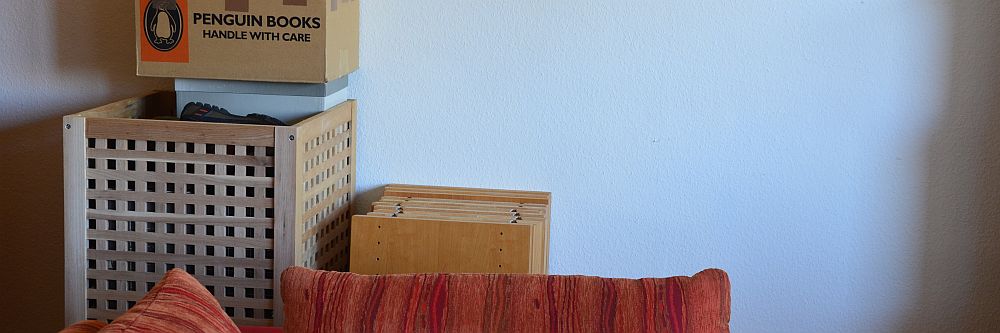
moving-books-box

We have moved to a country of red bricks, impressive trees and avenues – and horses.

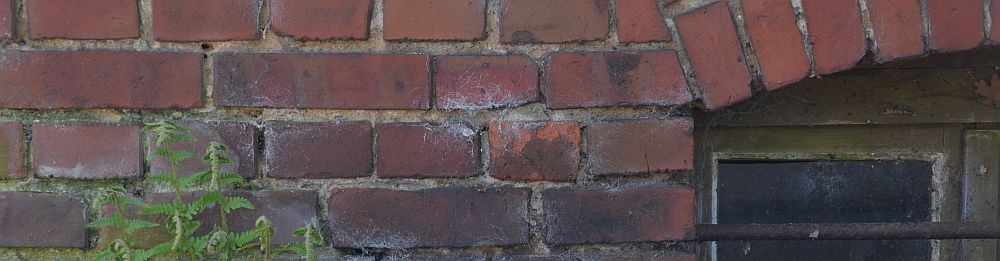
red-brick-wall

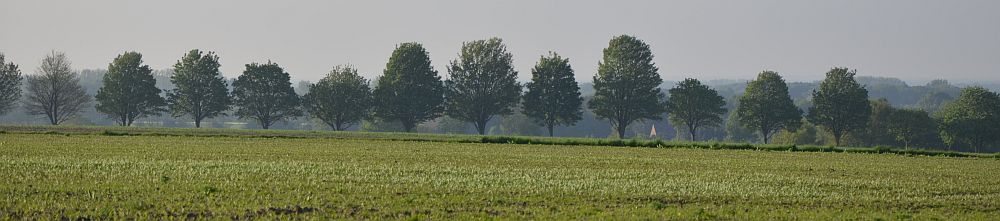
trees-in-line

horses-grazing

Before leaving the southwest I paid a final visit to the Museum of Literature in Marbach/Neckar. There are two famous places called Marbach in the southwest: one is famous for its horses and one for Friedrich Schiller. This time I went to the latter. In 2006 the new museum opened and it is a stunning building designed by David Chipperfield Architects. The current exhibition is discussing the specific character of the original piece of artwork as such. It goes without saying that the show is focussing on literature and writers. The exhibit is part of their series of „essay exhibitions“ and a nice little brochure is published alongside. The show will be on until September 13th. But by then we’ll be far far away…

Literaturmuseum der Moderne, Marbach/Neckar

Literaturmuseum der Moderne, Marbach/Neckar


LiMo-Marbach

At last the days came when things were going to happen. When we finally cleared the flat we had sunny days and frosty nights. Gradually the impression of a lived-in dwelling trickled away as bit by bit furniture and boxes left the place and got stored in the huge container.

moving-lonely-lamp

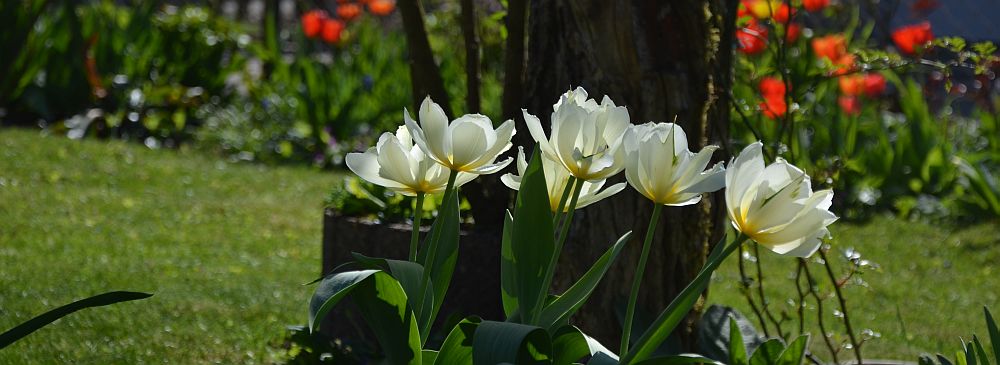
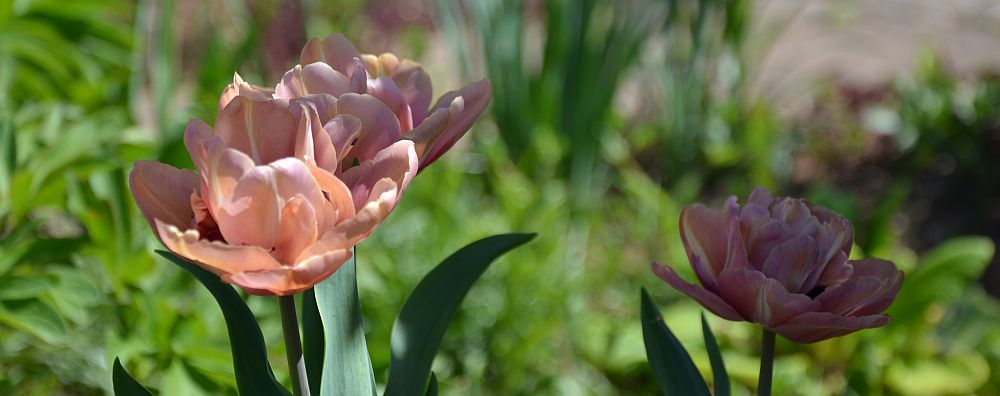
Our tulips on the balcony had only just started to open their flowers. The pots needed to be re-homed. They travelled to my mother’s garden where they will have all the care they can wish for as my mother is a passionate gardener. Since we will not have a garden for the time being, we only kept four pots of herbs for cooking including parcel, English mint, caraway and a few varieties of thyme.

moving-rehomed-tulips

moving-rehoming-tulips-salmon

On Saturday April 25th we hit the road heading northwest. Münsterland gave us quite literally a warm welcome: it was all sunny. Stuffing our core belongings into the smaller flat (while leaving the bulk in the storage container at the movers‘) was tricky but it worked out-we are now experienced.

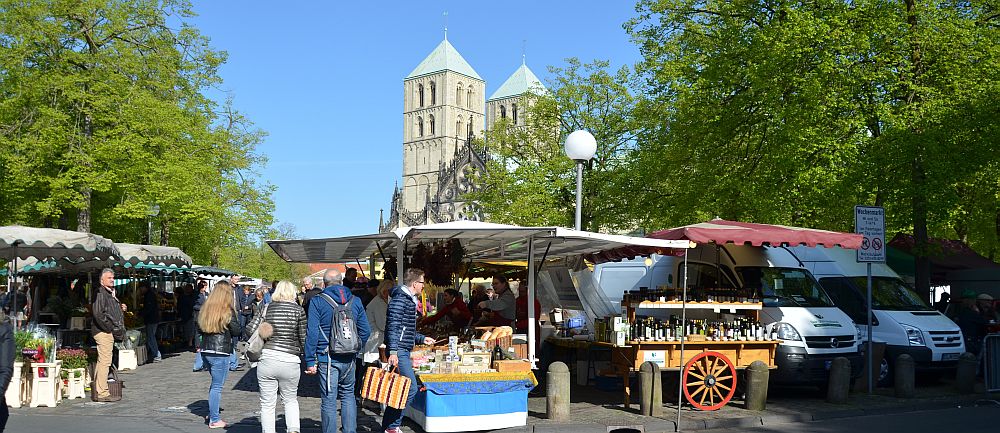
Farmer's market in Münster

Farmer’s market in Münster

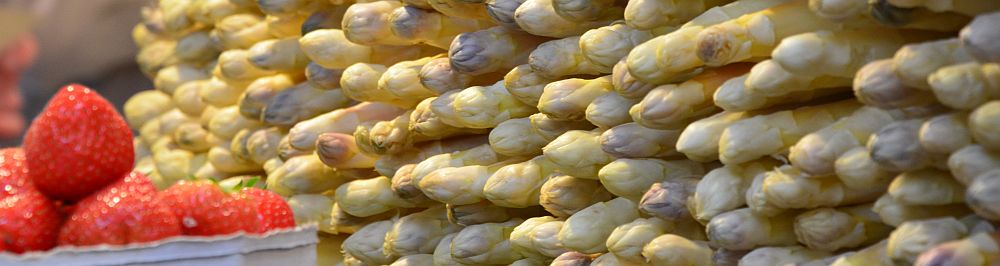
Next thing we were heading for was the farmer’s market in the city of Münster. The region is known for its tasty asparagus. The plants grow well in the sandy soils. The season has only just started and soon the strawberries will follow.

asparagus-strawberry-time

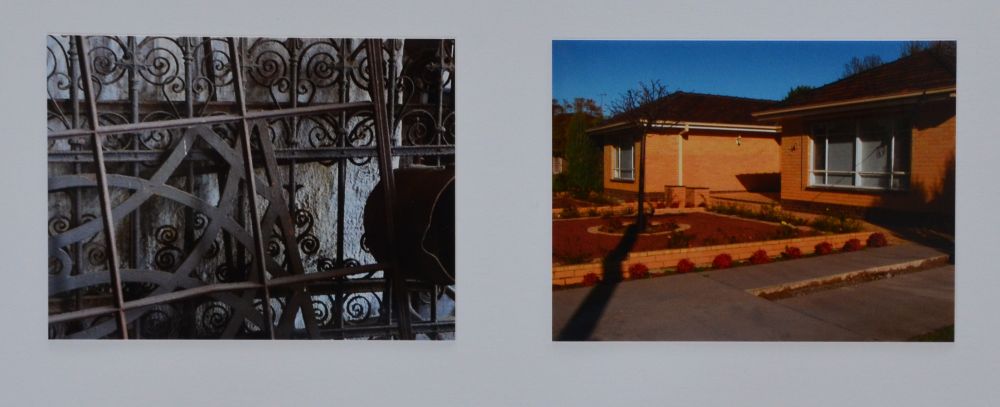
The market is spread out on the large space just in front of Münster Cathedral or known as Münster Dome. Virtually everything is decoratd neatly in the numerous stalls of the weekly market. The city of Münster is known for a wealth of things. Among them the abundance of sculptures.
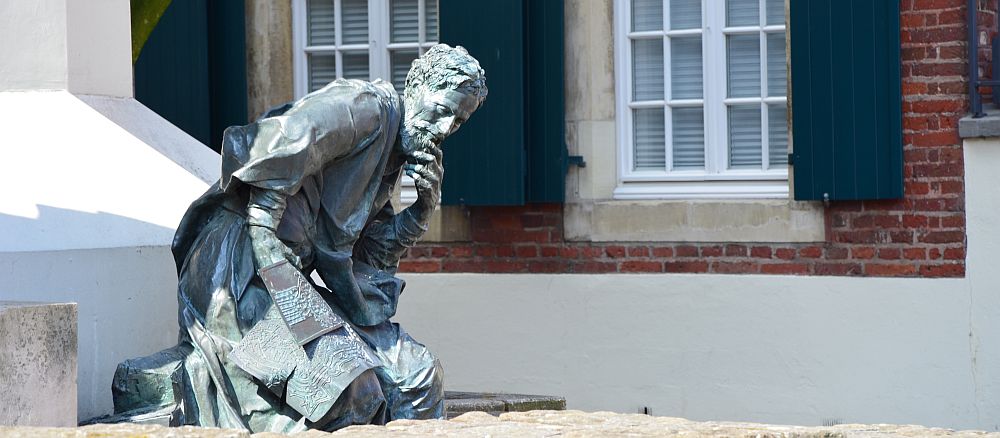
muenster-bronze


Church inNuttuln

Church in Nottuln

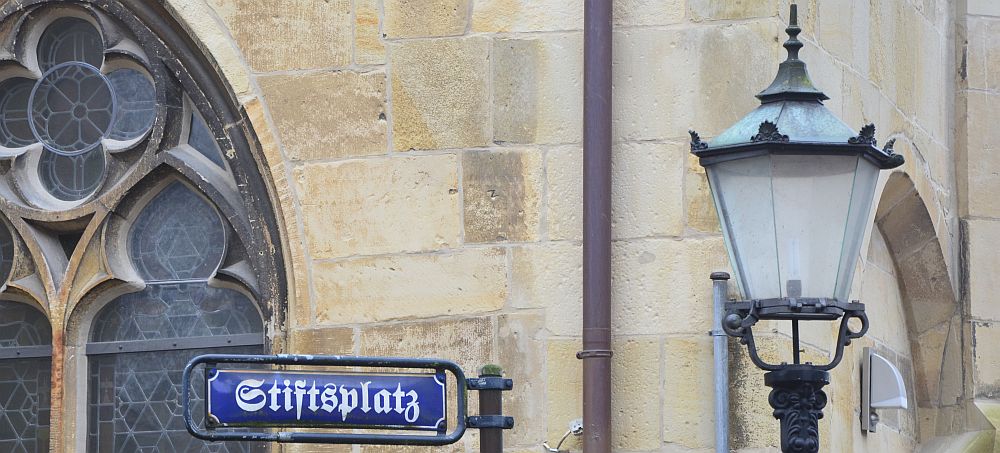
We are now living in a town called Nottuln, which is part of the region called „Baumberge“. Literally translated this means „Tree Hills“. While Münsterland is basically quite flat, Baumberge is an elevation of some 187 metres above sea level. It is the highest elevation in Münsterland. Baumberge is famous for its decently yellow sandstone. First quarries have existed some 1.000 years ago already. Baumberge Sandstone has been widely used during the past couple of centuries. Both, palace and dome in Münster were made from this quality of sandstone. Johann Schlaun, an architect of the baroque era, designed the town centre of Nottuln, combining the yellow sandstone with red bricks. The building works started in 1748 and the group of houses surrounding the parish church is still being used by the local government and as the town hall.

Wesel-Datteln canal

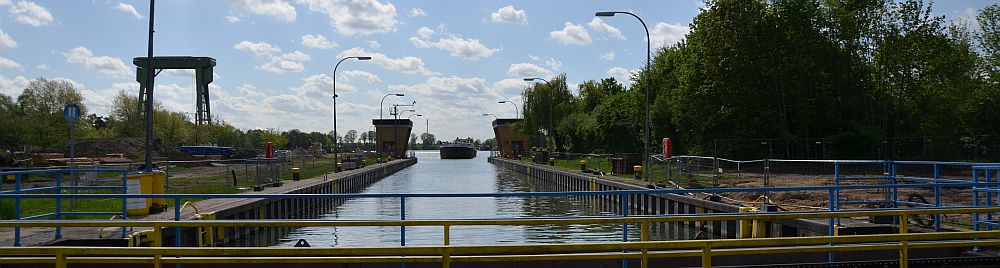
Funnily enough, once more I am living in the vicinity of a water parting. Here basically it means some streams drain into river Rhine, others into river Ems. Both rivers are navigable waters and there are a number of canals running more or less parallel to some of the rivers with locks and canal bridges. There is a waterways crossing not far from here, which is said to be the busiest stretch of water way in the whole of Europe. It is the crossing of Wesel-Datteln-Canal with Dortmund-Ems-Canal. It connects rivers Rhein and Ems with the industries in the Ruhr District and the large ports on the northwestern coastline.

Datteln lock

Datteln lock


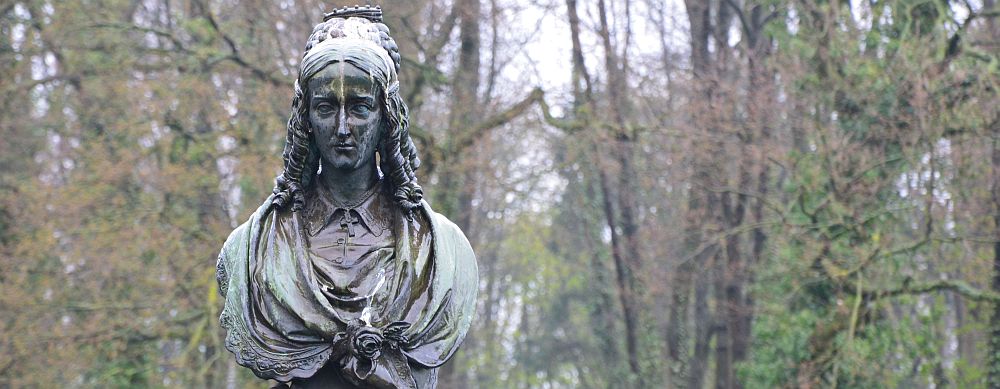
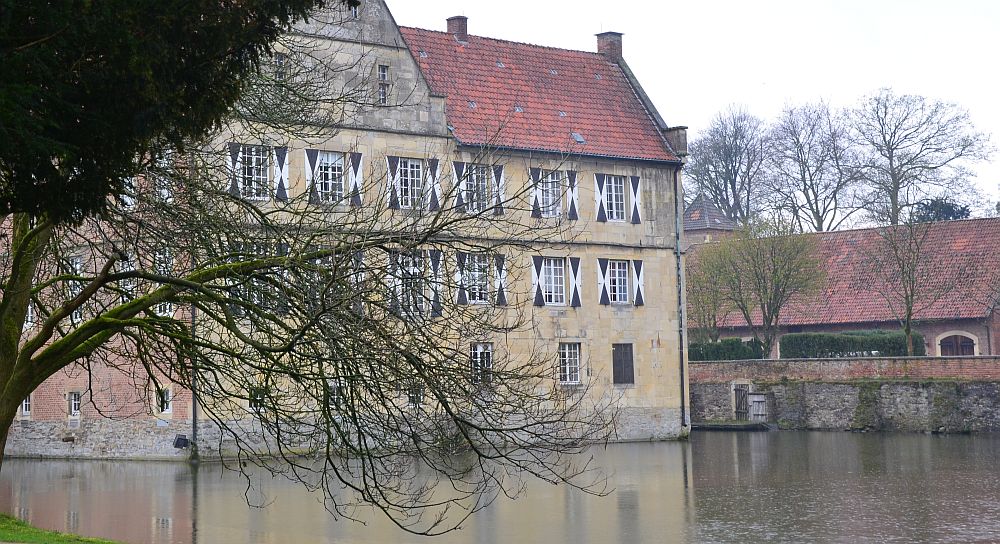
Also, not far from here and still within the region of Baumberge is a little town called Havixbeck. It is the home of famous poet Annette von Droste-Hülshoff (1797-1848). Her birth house is a moated castle in a beautiful setting and houses an exhibition on the life of „The Droste“. When visiting, you will be kindly asked to choose from the felt slippers provided in all sizes in the entry hall and put them over your shoes-as a precaution to protect the old wooden flooring and carpets.

Annette von Droste-Hülshoff

Annette von Droste-Hülshoff


Castle Hülshoff

Castle Hülshoff


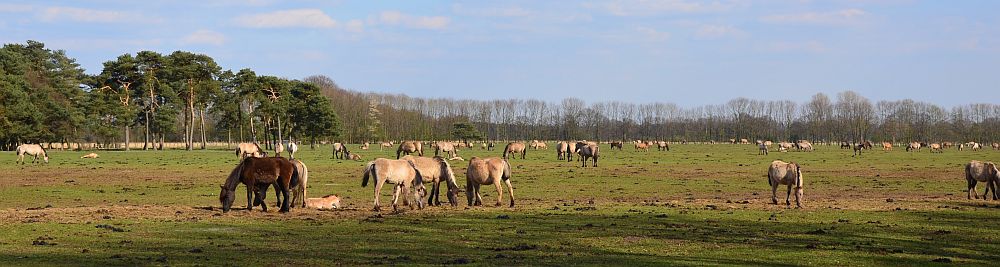
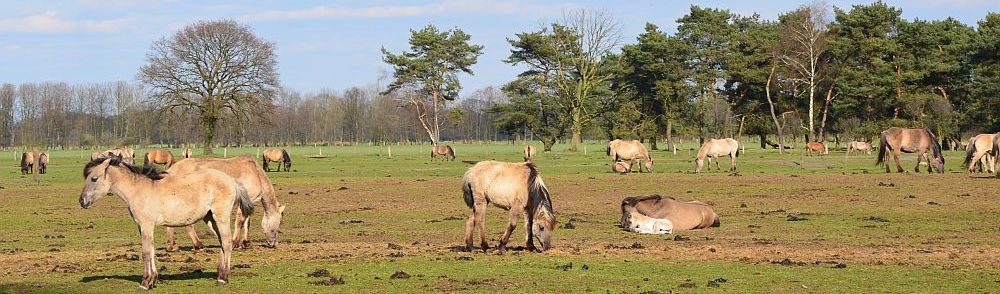
And, last but not least. There are the horses. This is a region of horses and horse riding, no doubt. But there are some very special horses here and they are roaming free on grazing land not far from the town of Dülmen. These are the famous „Dülmen Wild Horses“. It is a large group of some 300 horses basically left to themselves in a nature reserve of some 350 hectars. These horses have been kept here for centuries. They have been „Endangered Livestock Breed of the Year“ in 2014. The aim is to keep the breed as original as possible. The horses are small and very tough. Once a year a small number of young stallions will be caught by hand and auctioned. This is to keep the size of the drove fairly constant and to prevent excessive fighting between stallions once they have grown up.

wildhorses-of-duelmen


As I write this, it is, apart from asparagus season, rapeseed bloom. The very specific scent of rapeseed flowers is in the air virtually everywhere. It is sunny and warm-we did have some forceful downpours a couple of days ago.

rapeseed-scenery

Prior to relocating


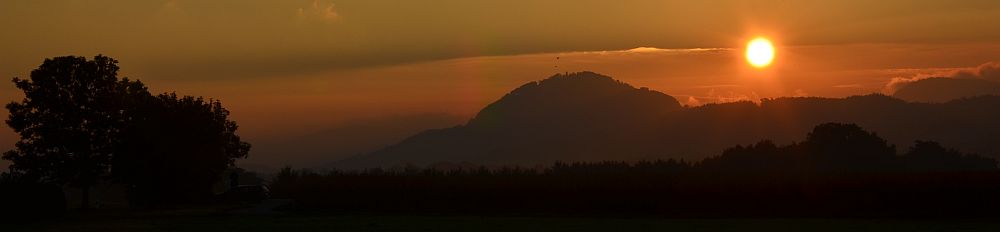
Rechberg - sunrise

Rechberg – sunrise

We’ll be relocating ourselves from the southwest of the country to the northwest, covering a distance of some 500 kilometres. We’ll be moving both our residence and my studio. The whole procedure will happen in several stages and take its time. Currently we are in a preliminary phase, i. e. we are packing. The flat is crammed with boxes.
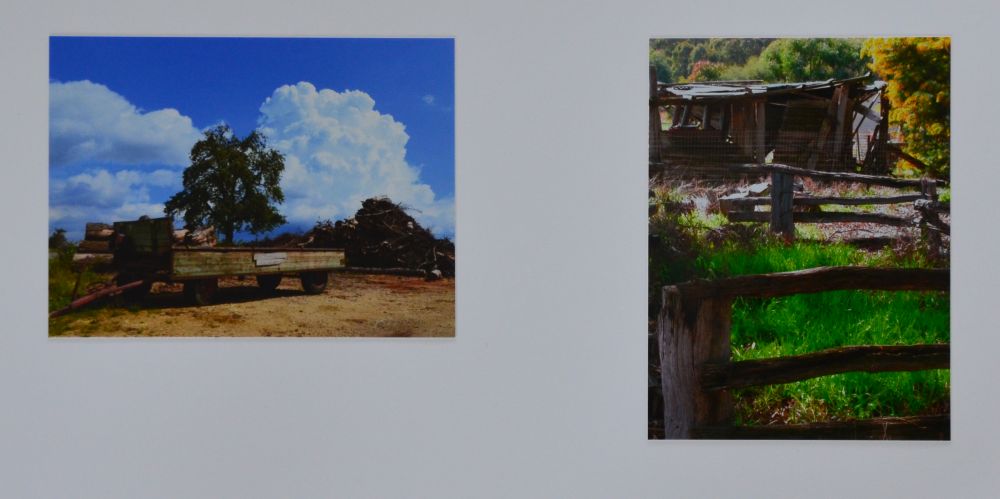
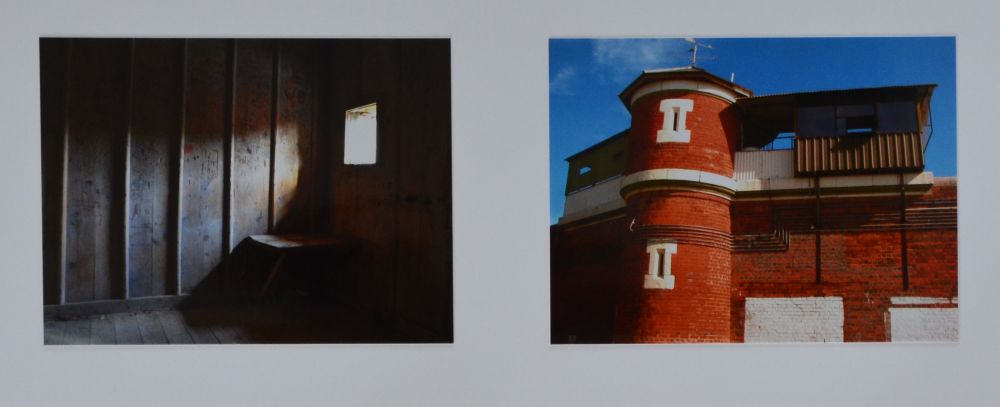
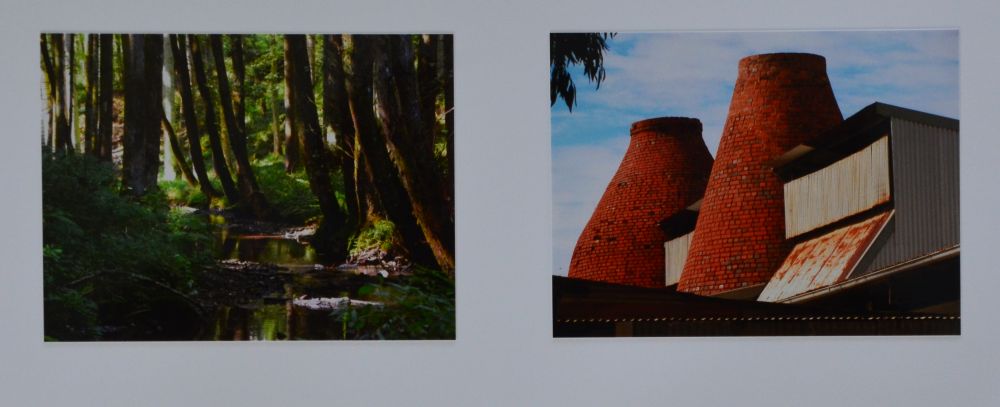
Yes, we do own some books. Has anybody out there ever been moving with books?

pan-schurwald-snow

pan-schurwald-summer

You can follow the progress of it all here. At one point it will come to relocate all those tons of metal type and printing gear, but for the time being the studio will stay put in the south. The first step will be to move our residence. We expect the pantechnicon to come and collect our belongings by the end of April.

Schurwald stretching north with castle Waescherschloss (below right)

Schurwald stretching north with castle Waescherschloss (below right)

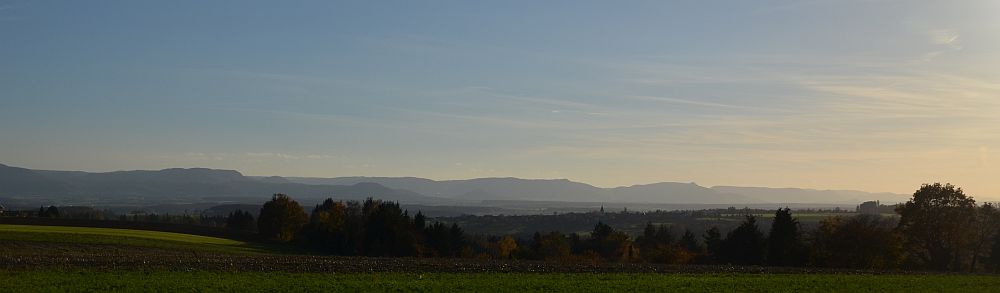
Today’s blogpost will fill you in about where I’ve been living those past four decades. The region is called „Schurwald“. It is a mountainous part of the most southwesterly state of Germany. „Schurwald“ is located fairly central in Baden-Wuerttemberg, east of the state’s capital Stuttgart and just north of the famous „Swabian Mountains“ or „Swabian Alb“. Looking south from the peaks of the Schurwald mountains you’ll face the impressive skyline of this geological formation known for its abundance of fossilised dinosaurs. The „Schurwald“ is a wooded area with meadows and pastures interspersed. It is all hills and slopes and valleys.

Skyline of Swabian Mountains

Skyline of Swabian Mountains

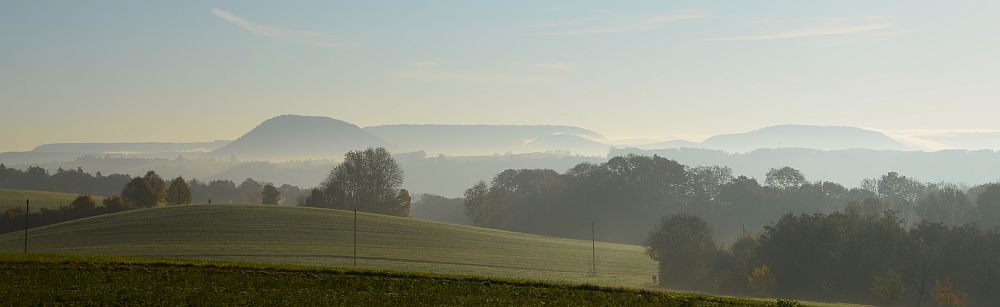
Mountain Stuifen with fog in autumn

Mountain Stuifen with fog in autumn

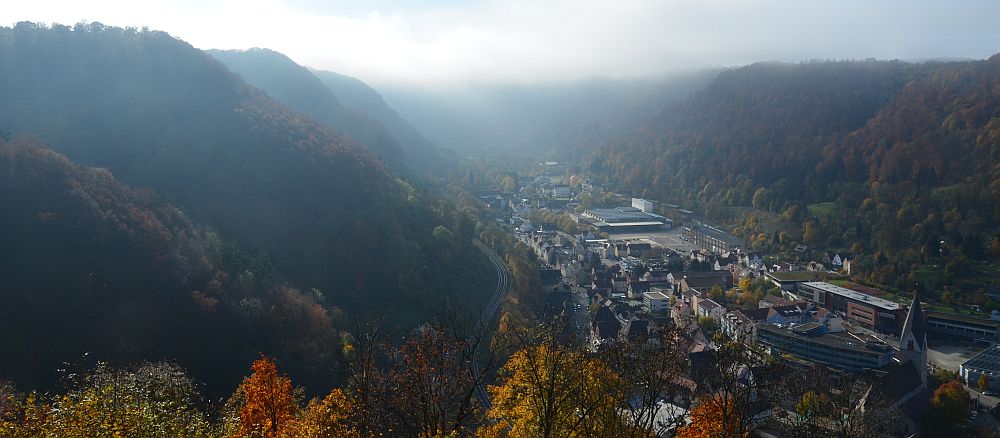
I have moved here with my parents when I still was in primary school in the late 1960s. I spent my younger years in a small town down in the valley of a stream called „Fils“ whose waters eventually end up in the river „Rhine“ draining into the North Sea and Atlantic. This is a fact to be noted as not far from where I live you can find what is called the European Watershed and the more southerly and easterly streams and rivers will drain into the Danube and the Black Sea instead of the Atlantic Ocean. The Fils valley is densely packed with businesses many of them related to the automotive industries with the headquarters of Mercedes and Porsche in the vicinity. However, in the even smaller valleys of the Fils tributaries there can still be found charburners working in tiny hamlets.

View from derelict castle Helfenstein overlooking the town of Geislingen/Steige

View from derelict castle Helfenstein overlooking the town of Geislingen/Steige

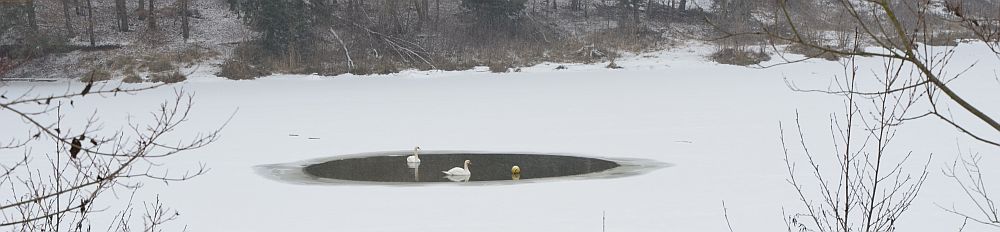
Herrenbachstausee - a water reservoir frozen in 2012

Herrenbachstausee – a water reservoir frozen in 2012

When I got married I moved uphill to the village Wäschenbeuren, which is at an elevation of 442 m. Up here you do get a fair share of snow in winter. It can be pretty frosty, temperatures may plummet below minus 20 Centigrade. We’ve had seasons with such conditions lasting for days and even weeks. In February 2012 we had a period when a rush of bitterly cold arctic air froze everything rock solid for as long as two weeks. There have been considerably longer periods of cold in the not so distant past of the 1990s.

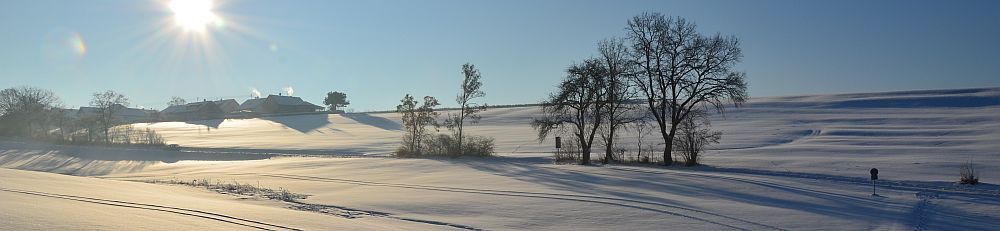
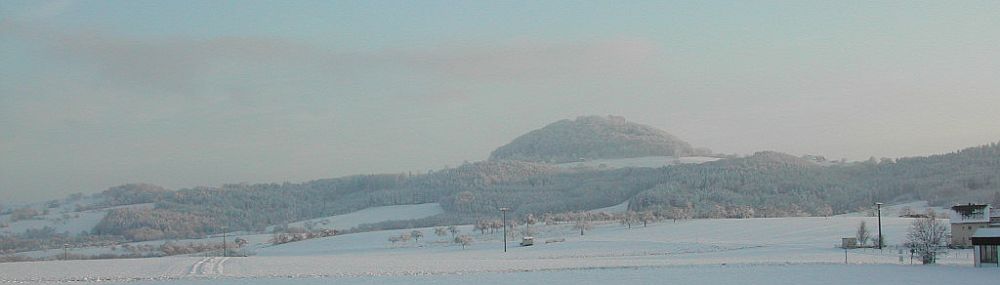
Mountain Hohenstaufen in winter

Mountain Hohenstaufen in winter

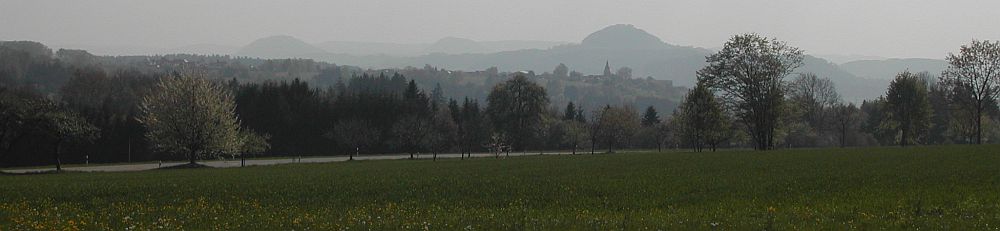
Mountain Hohenstaufen in spring

Mountain Hohenstaufen in spring

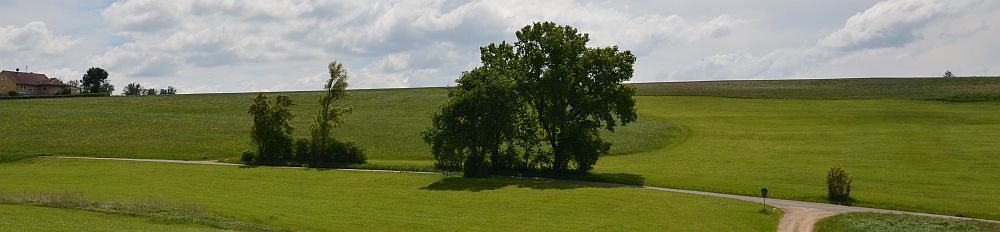
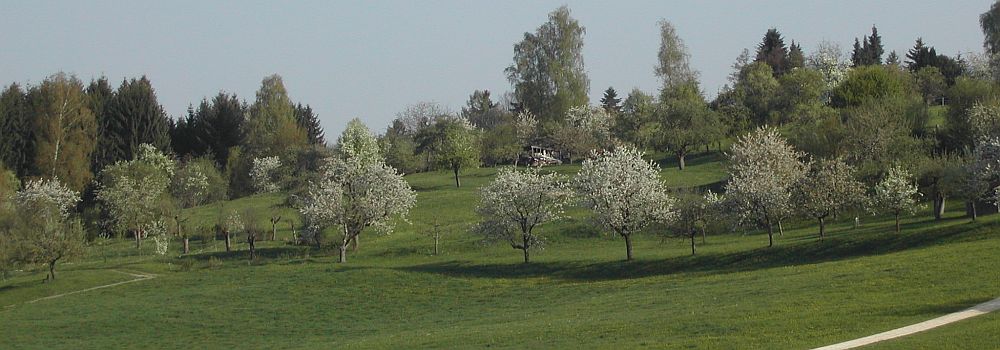
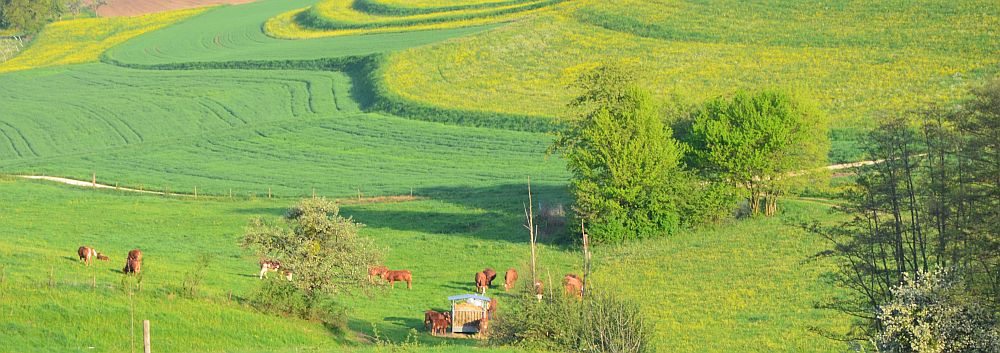
Spring is a beauty around here with all the fruit trees blossoming covering the slopes in a veil of white and a tint of pink. The soils are fairly rich and we do have lovely hedge rows with blackthorn and lilac and a great variety of shrubs and trees. There is a lot of meadows and in recent years more of them are being used as grazing land, while still many are mown. On the fields cereals are grown and of course corn and rapeseed, the latter colouring large stretches a bright yellow when in bloom.

Fruit trees in spring

Fruit trees in spring


Cattle grazing

Cattle grazing

„Schurwald“ is Red Kite country. We have a good number of those impressive birds of prey living here circling the summer skies.

Resident Red Kite

Resident Red Kite


Forest in May

Forest in May


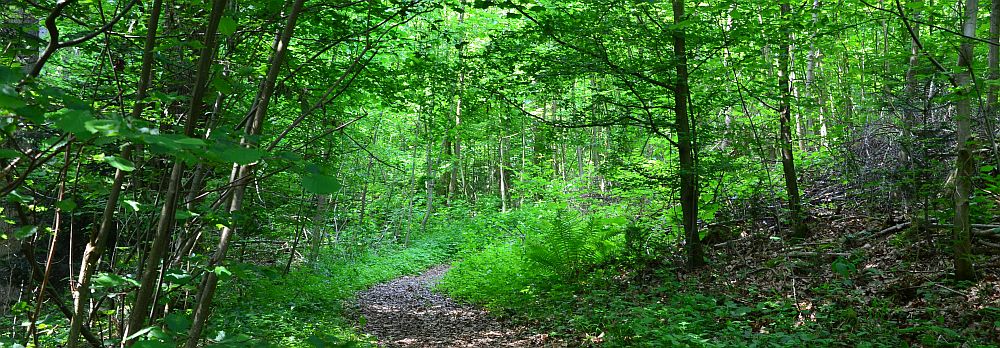
Basically the forests are classical beech groves with bear’s garlic and lily of the valley in spring, turning shadowy during summer with the canopy keeping the bright sunlight out. The valleys of the small streams can be very quiet and peaceful. There was a severe winter storm on Boxing Day in 1999 called „Lothar“ causing an incredible amount of rolled lumber in a vast area stretching from France right through to the eastern border of Germany. This storm hit „Schurwald“ very badly.  It took the lumbermen years to deal with the damage.

Forest in 2005, six years after the big storm

Forest in 2005, six years after the big storm

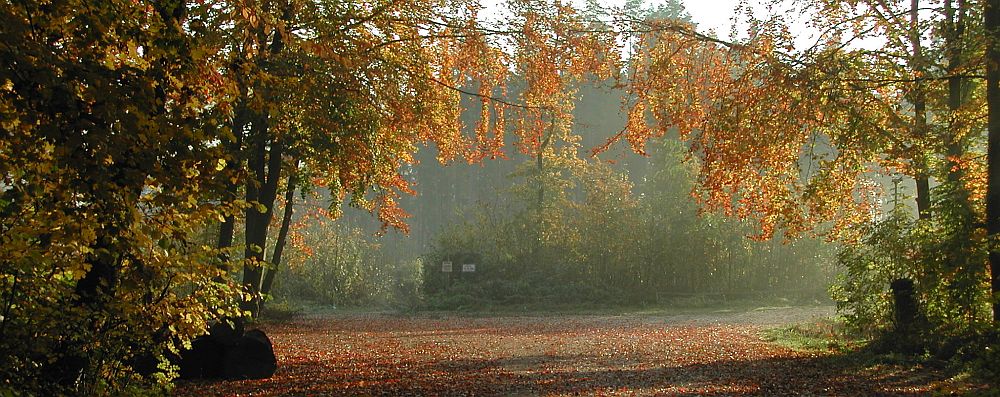
With all the hedge rows and woodland autumn is almost even more beautiful than spring. The scenery will change from the dull late summer’s green into all shades of vibrant yellow to deep burgundy. With the weather being favourable this can last for weeks and is a real treat.

Mountains with autumn fog

As I write this a spring storm lashes the streets. Gushes of rain drench any person who felt brave enough to dare to go outside, their dogs having this disgusted look on their faces for their owners having chosen to walk them in such a particularly bad weather. It is one of those cold and wet and bleak and rather unpleasant days of spring that will make your front door rattle with disagreement.

52 Weeks – A Photobook


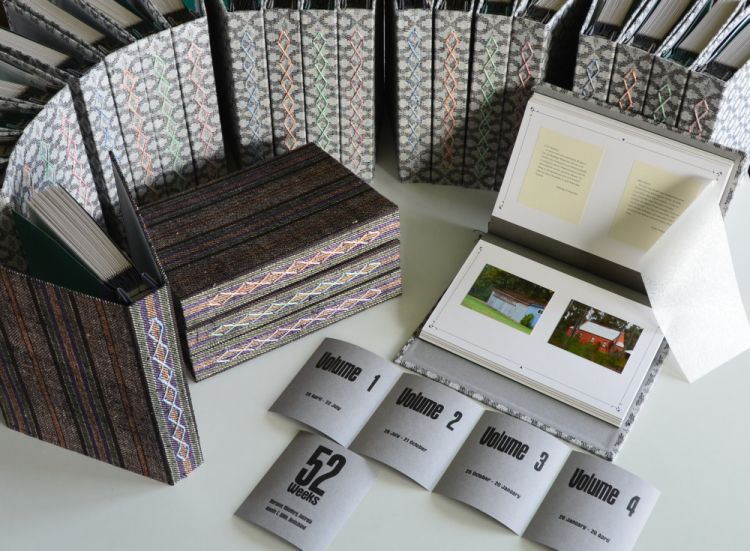
52 Weeks. The edition.

52 Weeks. The edition.

Title Pair Volume 2

Title Pair Volume 2

„52 Weeks“ is my first photobook so far. In a previous post I have outlined how I came to be making this book in the first place. The post came with both a portrait of my fellow artist Marianne Midelburg (who of the top of her head said „Yes!“ when I asked whether she would like the idea of making this books together) and me. The post went online in April 2014, days before I presented the book at Turn The Page artist’s fair in Norwich.

Week 5

Week 5

Week 8

Week 8

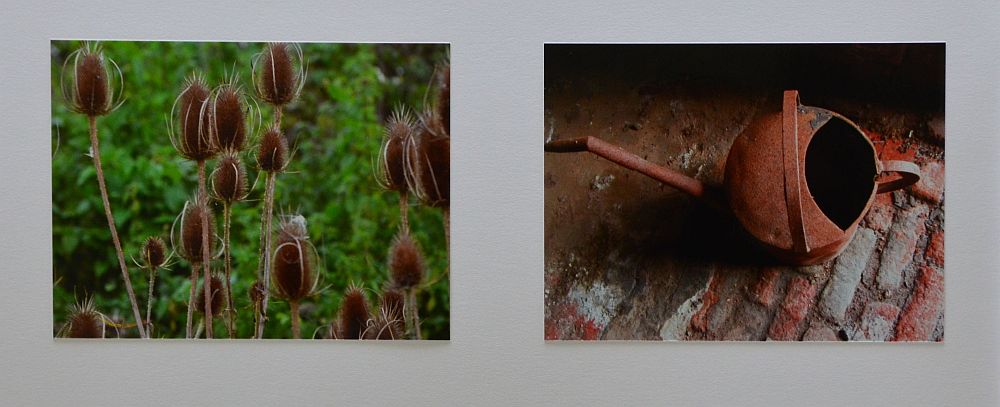
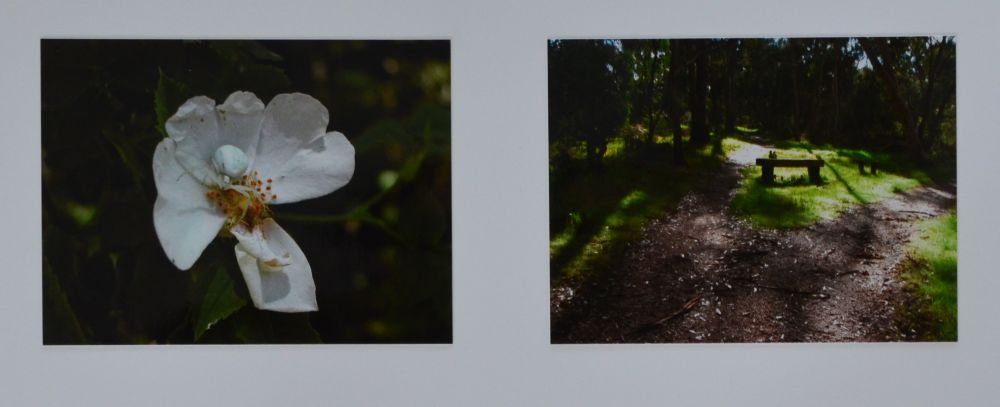
Now, this current post will go in more detail as for the photographs in the book and some further aspects of interpretation. For all of you who have not yet read the previous post, these are the basics: two artists, one from Australia and one from Germany, each took one photo per week for one whole year. This resulted in 52 pairs of photos. Also, each photo comes with a short commentary written by the respective artist. Thus the book presents 52 pairs of moments from the every day life of two artists. All photos have been taken in the vicinity of the places where we two artists live.

Week 10

Week 10

Week 13

Week 13

The artist’s book „52 Weeks“ is about those little every day life things and moments in our surroundings we tend to drop out taking notice of after some time. At some point we just take them for granted, or simply walk past. „52 Weeks“ is a book that asks for our mindfulness, it asks for what makes things familiar and what makes them alien to us. It asks for what makes us feel at home, quite literally but also in a broader sense, and what makes us feel a stranger.

Week 17

Week 17

Also, this book is about what we treasure. It is about a very special tree growing in some field. It is about that one particular bench on this one particular path through the bush and this one quiet spot in a wood we go to again and again because it makes us feel at home in some sense. It is about this very special scene in autumn when the fog is still asleep in the valleys and the hilltops stick out, underneath a spotless blue sky with a blazing morning sun; a moment that is just awesome. It is about that small creek bubbling with water after it had run dry for years. And it is about the white frost in the coat of grazing sheep and goats on an icy early winter morning. This book is about those places and moments in our vicinity we treasure, whether or not we are aware of doing so.

Week 19

Week 19

Week 21

Week 21

In one sense „52 Weeks“ wants to make us become aware of how different and, at the same time, how alike our own life might be compared to somebody else’s life. And it is not necessarily the milage that makes the difference. Our next door neighbour might live a life totally different to us while the every day life of somebody thousands of miles away might have much in common with our own. The book wants to make us reconsider our preconceptions.

Week 23

Week 23

Basically, most of my art work is to do with humaneness. As for that „52 Weeks“ does not make an exception. Our attitude towards the situation of others and towards our own situation might change dramatically once we try to put ourselves in the other person’s place. This is the moment when enmity, preconceptions, discrimination and humiliation all of a sudden lose their basis. They just fall to pieces as we realise, we all are human beings after all. We all prefer not to be offended, but approached with kindness and respect, whether counting as local or foreign. We all wish for a safe and peaceful life. And for all and each of us there are those small things and those precious moments in our surroundings we treasure and that make us feel at home. And we all do not want to take the blame for other people’s crimes, just because we happen to have the same skin colour, religion or nationality as the criminals.

Week 25

Week 25

These might well become aspects in the case that you will not be staying in that particular place where you’ve been born to live there until the day of your death. There are countless reasons why you might leave or be forced to leave the place that was home to you. It need not be war or terrorism or starvation. But it can well be. You might not move far or the trek might take you around half of this planet. In either case you might find yourself being called a stranger, being alienated, refused access to a community. This might or might no be for the colour of your skin, your religion, your language or even accent, the clothing you wear. All this can be the wake up call for preconceptions, humiliation, bullying.
This wants to be read as a plea for a policy of open arms&minds rather than one of closed borders – in heads as well as in nations.

Week 27

Week 27

Week 30

Week 30

What makes us feel at home is tightly connected with what feels strange to us. Both are just two sides of one coin. One makes us feel safe and comfortable, the other scares us. Fear towards what we feel is foreign is the least appropriate coach imaginable in a society wishing for peace. Fear tends to generate hatred. And acts of hatred tend to produce new acts of hatred. We need a world of understanding and respect, if we want to drain hatred from its powers and create a world of peace. I strongly believe that there is no overcoming war and terrorism by shooting back. And I am convinced that peace and freedom cannot be gained by air strikes or snipers or assassins. It is a sad coincidence that I write these words just days after the shootings in Paris.

Week 37

Week 37

It is our mindfulness that can make us stand strong against all hatred.

It all starts on our very doorstep.

Week 43

Week 43

There are many more offers and options to be found in this book. Go and find yours.

My books do not want to restrict your thinking, my books want to enhance it.

Use your thinking, that’s what you’ve been given it for.

Week 45

Week 45

Week 47

Week 47

Technical notice: In this post not the original image files have been used. All photos included here are shots taken from the books itself. This was done to keep the book feeling alive, even though it meant that the photographs themselves lose some of their brilliance-which they have, I can assure you.

The artist’s book „52 Weeks“ has been published in a limited edition of 6 numbered copies, each signed by both artists. Each book consists of 4 volumes. The book is a collaborative work of art by Australian artist Marianne Midelburg and German artist Annette C. Disslin. Copy No 1 is the special edition and comes with two extra photographs, one by either artist, that can be framed.

Week 49

Week 49

Find the former post on „52“ Weeks“ here on this blog in the category „Artist’s Books“ or in the Archiv of April 2014

Find more information on my work and studio on my website.

 52-weeks-selfie-DSE_6218

Escaping the Embers

escaping-the-embers-det-DSE_6108

We did have a TV-Set when I was a child. I remember the news about wars and bombings in Northern Ireland and the Near East. I am not aware of the exact moment but at some point I must have tried to imagine what it must be like to be a child growing up in a war zone. I don’t seriously think you can imagine it without having been forced to go through the experience. It is about losing loved ones, running for dear life, losing all you ever had, your toys, your home. And it is all about living in an atmosphere of hatred and devastatingly real threat. But it is also about being bereaved of your future. There will be no schools or no time to attend lessons because everybody is occupied with hiding, finding food, staying alive. There will be no paper to write your homework on, there will not even be homework. There will be no books to study from, because they have been burnt down together with the libraries.

absence-presence-metaltype-DSE_6096

When we, as a family, went for a swim, it was familiar that there was a crater as wide as a flat hand in my father’s back. It was a large deep scar where the bullet had struck and almost killed him in WW2 when he was barely 20 years of age. It was his largest scar, but not the only one he had. He would not answer questions and I felt I’d better not ask. He lost one half of his lung and almost all of his joyance. He would say he had unlearned to laugh. This, also, is something war does to people.

al-mutanabbi-broadside-DSC_7606

It is difficult to resist passing on the hatred if you have been affected by it in the depth of your heart. It is much easier to give way to vengeance. It will need much effort to not succumb to revenge. In this effort knowledge will be of great help. To know about foreign people and their countries. To know about ways of living different to your own. Knoweldge about other times in history, other cultures, other religions. Knowledge can calm down fear and will support understanding. Studying will make friends in that we can see that there is not just the one way, but that there are many ways of living a good and happy life. These are pretty old findings. People of all cultures have realised what the essentials of a good humane live are millenia ago. First they passed them on to the next generation by telling them, in myths and fairy tales. Later they wrote them down on parchment, and still later they printed books to have them spread to still more people. All the books tell of the longings and sufferings, of how to overcome misery, and how to succeed in living a peaceful life. It is the means by which this can be achieved where the argument starts. The deliberate demolition of books, libraries, schools, bookshops, publishing houses, archives is unpardonable. Precious knowledge will be lost past recovery. People are depredated of the possibility to study and become educated. People won’t be able to form an opinion if they are denied free access to information. If they are at the mercy of censored messages they will have their minds manipulated and are prone to be turned into instruments of war and hatred.

To deliberately keep people ignorant is a serious criminal act and will perpetuate war.

escaping-the-embers-DSE_6093

Escaping the Embers: My print for the „Absence & Presence“ project

Prior to printing I painted the sheets individually in the colours of flames and ashes, with paint prepared from soil pigments. Into the zone of the ashes I printed the astronomical coordinates of 33 libraries that have been burnt down over the centuries, from Alexandria in 391BC to Tripoli in 2014, marking places where wisdom and cultural heritage have been destroyed deliberately. Rising from the embers of the burnt down libraries of the world two pairs of scribbled pages, like a butterfly’s wings, take flight in a flurry of ashes. Handwritten on those pages are the fundamental ideas of mankind, the essentials of wisdom, believes and knowledge, the writings‘ characters resembling the alphabets or scripts used in the world: Arabic, Latin, Hebrew, Asian …

absence-presence-proof-DSE_6101

The butterfly carries these ideas as if they were its precious eggs. In butterflies the eggs will become caterpillars, which develop into cocoons and further into new butterflies. With written ideas it is similar: they are laid into their readers‘ minds to hatch into thoughts, grow, cocoon and eventually hatch as new beautiful knowledge – be it as poems or novels, scientific work or philosophical wisdom – and new books.

In the end nothing will be lost. Arson cannot win. And with the flap of its wings this very special butterfly will change the course of things in this world eventually. Over and over again if need be.

My print is a print of hope.

Butterflies are fragile and vulnerable, but with their swaying flight they escape risks just by following their nature. A butterfly seems to be absent at times, but some of its live’s stages might be present without us being aware of it. Also, the butterfly motive refers to the butterfly effect as known in chaos theory: Small differences, like the beat of a butterfly’s wing, may result in an overall big difference in the course of things.

absence-presence-press-DSE_6102

„Absence & Presence: A Printmaking Response to the bombing of Al-Mutanabbi Street“:

With this project one complete set of prints of all participating artists will be donated to the Iraq National Library in Baghdad. Three copies will be part of touring exhibitions worldwide. The fifth copy will, together with work from the project at the Herron Art Library (Indiana, US), be digitised to become part of their permanent collection.

Last year I was invited to be part of „Absence and Presence: A Printmaking Response to the bombing of Al-Mutanabbi Street“. My deadline to hand in my prints was 11 October 2014. The day before Malala Yousafzai was awarded The Nobel Peace Prize. Two years ago, aged only 15, the Pakistan teenager was shot and almost killed for promoting and fighting for the right of education for all children, boys and girls, wherever they live.


If you wish to know more or to become involved, e.g. with readings, talks or activities connetced to the „al-Mutanabbi Street Starts Here!“ projects, you might want to check any of these:

Facebook Group

The coalition’s website

The online gallery at UWE in Bristol (UK)

The German-English website of the al-Mutanabbi projects

Photos of al-Mutanabbi Street

The coalition published an anthology to which 125 writers and poets have contributed. You can purchase it.

al-mutanabbi-anthology-DSD_2454

There is a catalogue of the exhibition of the Inventory project at the Center of Book Arts in New York 2013. You can purchase it.

catalogue-inventory-DSE_5909

Find more on the Inventory project on this Blog at May 2013 „John Rylands Library Manchester“


Matrix 32 Featuring Kurt Tucholsky

matrix-32-article-DSE_3862

Check in for the ferry to Harwich was in the evening of April 30th at Hoek van Holland port. So far we had been on the route before but only on a trip at daytime. In that case you’ll disembark around 8pm at Harwich port. That was last year and we had booked a room in a small B&B not far from Harwich, the Sleepy Fox which is in the back of the Layer Fox Pub. We got there rather late almost starved, and even though the kitchen had closed already they didn’t hesitate to serve us whatever hot they could make as late as that. So we were facing a medium size mountain of all sorts of finger food plus a huge bowl of chips each. We had been experiencing a challenging journey through what in daylight would turn out to be a wonderful countryside with colourful pheasants popping out from virtually every bush or hedgerow. However, that first evening we had to find our way tired and whith dusk closing in. What was even more challenging: as we had not yet adjusted to having left the continent it felt as if we were going on the wrong side of the road all the way.

layer-fox-DSD_6110

This year we decided we might quite as well choose the ferry trip overnight and book a cabin to sleep in, so we could face the challenge of driving on the left side of the road after a good sleep. We didn’t regret it in any way. We loved the large window to look out on the sea and we got off the ferry at Harwich early in the morning taking in the scenery in full day light on the route to Norwich. It was Turn The Page time again and I was one of the lucky ones who had been chosen to exhibit there. We spent three wonderful days in Norwich. The fair was in The Forum again, a stunning building right in the middle of the city centre housing the library. It was great to meet everybody at the fair, colleagues we met last year and others we hadn’t met at all so far, or whom we hadn’t seen for years, like Martyn and Angela who are running „The Old School Press“.

harwich-port-early-DSE_2662

When the fair was over we were headed west. Next stop on the way was Oxford and we were lucky to pick a pretty warm if not to say hot spring day with bright sun. We got into Oxford on the Sunday and everybody was out relishing their ice cream cones or enjoying a boat trip or having a look inside the colleges. Our B&B was even further west and we got there in the evening. Given the choice we did take the room to the back even though the one to the front offered the full view of the Cotswolds. The room on the back was facing towards the garden which was just beautiful and filled with bird song. Right in the back they were keeping hens. They were all re-homed as they had not been kept porperly at the place they were before. It was their eggs we were served for breakfast.

oxf-cov-mark-DSE_3166

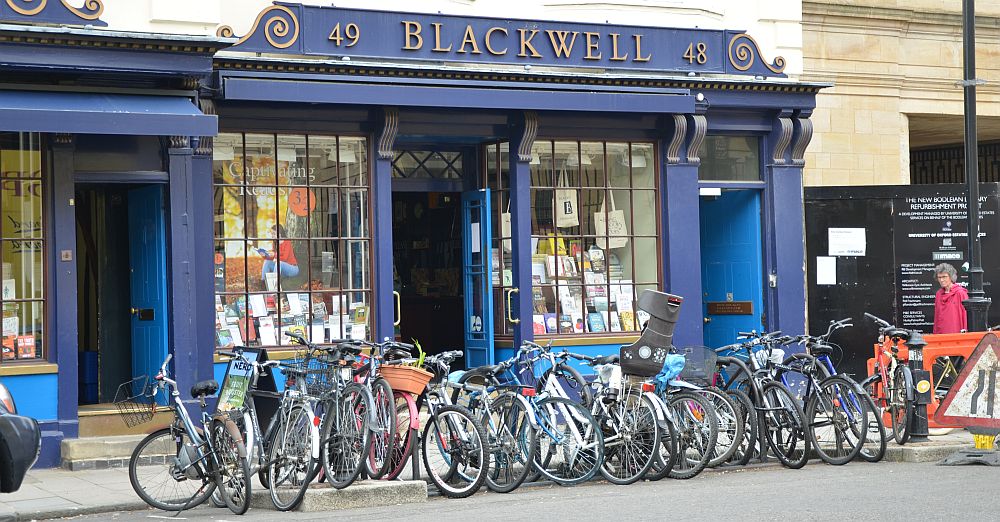
We went to Oxford one more day strolling the streets and lanes, visiting the Bodleian, spending hours at Blackwell’s bookshops and having tea and cake in the Queens Lane coffee house („serving quality coffees since 1654“). I had come to love this place when I was here in 2011 visiting the Fine Press Book Fair and seeing Oxford for the first time – after having been here as a teenager and not rembering all that much apart from that I had been taken to some then famous ice cream shop. (And as I simply love Oxford’s Covered Market that was of course where I ended up in.)

matrix-at-whittingtonpress-DSE_3052

We had  just one week’s time all together and we spent the days we had left in the small Cotswold villages around where our B&B was. This included a visit at Whittington Press in Whittington. The press is on the premises of Whittington Court. Infact, the old gardener’s cottage has been giving home to the press ever since it was founded back in 1971 by John and Rose Randle. A group of American woodengravers was staying on their tour visiting colleagues and we had been invited to join in. It was a wonderful sunny spring day, a nice multicoloured Comfrey was in full bloom and everybody was cheerful. We did have a nice and relaxed picnic lunch beneath those large trees in front of the press‘ home. This was on May 5th and the first copy of Matrix 32 was lying on the table to browse. The more than 600 copies of the limited edition were still at the binders then. Meanwhile they are out and a fascinating read.

whittingtonpress-window-DSE_2991

whittingtonpress-binders-DSE_3062

Matrix is an annual review for printers and bibliophiles. It is made the traditional way: letterpress using metal type. Issues come with a wealth of thrilling articles about people, places and activities in the field of fine printing and book arts from all over the world. Every issue not only comes with articles it also brings original prints as inserts made by various presses and artists introduced in the articles.

matrix-32-title-DSE_3837

I am happy beyond words as an article on my artist’s book on Kurt Tucholsky is part of Matrix 32. It all began at the „Norddeutsche Handpressenmesse“ in Hamburg in 2013. This was where we all met and John suggested having an article on the art work in the upcoming issue of Matrix. Plus he thought it would  be nice to have an insert as well. My heart sank when I heard we’d need 700 copies. I am working with proofing presses that are operated by hand. I am feeding every sheet in myself one by one. My editions usually range between 6 and 20. Printing cards I might do around 40. Never ever had I got anywhere near 700. I considered the task and decided the only way it could work was to print the inserts on the younger of my two presses. It is a Grafix with a motorised inking system. The printing is done by hand still.

proofing-press-DSD_7777

matrix-32-insert-making-DSD_8182

But there was more to the task than the printing of the sheets. I choose a text in which Tucholsky describes why he is writing. I handset the text from Optima. It is printed on a white Zerkall deckle edge paper. The insert was supposed to be in the same style as the prints in the original artist’s book. So the insert wanted stickers giving the year the text was first published. Now these stickers had to be printed on a pretty old fashioned gummed paper in fading orange, moisted and glued to the prints. Additionally the prints had to be stamped and embossed. In the end they looked really good and off they went in a cardboard box addressed to Whittington nr. Cheltenham.

matrix-32-insert-making-DSD_8378

Now if you wish to have one of Matrix 32 or any back issues for yourself you can easily order them at Whittington Press. Or come to their Open Day on September 6th. You’ll find all information on their website.

matrix-handout-DSE_3848

Here goes a huge heartfelt Thankyou to John and Rose and everybody else involved in making Matrix 32 such a wonderful read. I am ever so glad that I was given the chance to be part of it.

If you wish to read more about „Norddeutsche Handpressenmesse“ or on „Turn The Page artists book fair“ find a blogpost for each of these events in the category „Fairs and Markets“ here on this blog.


My Workplace


„Among the objects of cultural value, mutually exchanged between the nations, next to artillery shells come books.“ Kurt Tucholsky, 1931


scenery-feb-DSCO1143

My studio is situated in a rural area. Almost everybody visiting me falls for the view through the back windows. These windows are large and face east. Since I moved in here in 2004 I have seen many breathtaking sunrises and thunderstorms, I have been watching the local pair of Red Kites circling the sky for prey. I saw the farmers plant rapeseed after maize after barley and I watched snippets of golden straw dancing in the wind after the fields had been harvested. I have seen people of all ages walk their dogs of all breeds and mixtures. I have seen downpours and whiteouts, crimson coloured full moons rising and whitefrost making the scenery look totally unreal. But first of all I have been doing my work here: cutting wood blocks, printing metal type, folding sheets of paper, binding books.

compositors-tools-DSD_4123

My first proofing press is 100% hand driven: it is a 1956 built Korrex Hannover I bought in late 1998. It printed most of my books, the first one in 2001 by the title „Little Niak“, which has sold out some years ago. The photo shows me inking the rollers.

work-proofingpress-_MG_6082
Image by Fabian Schroebel, 2011

proofing-press-DSD_7777

In 2010 I moved around most of the type racks to make space for a second proofing press. It is a 1964 built Grafix press on which the rollers are motorised, so to speak, but the cylinder is hand moved. On this press I printed my two recent books „Cumbria“ and „52 Weeks“.

woodcut-block-DSD_5177

„Friend you stand on sacred ground, this is a printing office.“ Beatrice Ward, 1932

trajanus-proof-DSD_8787

I have some 100 type founts on stock from which I can choose, mainly metal, some wood type. They are stored in racks of very different ages, some rather old and worn. There is also a fair share of ornaments and lines for printing and some quite sophisticated tools.

metaltype-goround-DSD_3030

metal-ornaments-DSC_0806

work-typecase-_MG_6254
Image by Fabian Schroebel, 2011

From the total of 15 books I have made so far, 10 have been made here at this workplace. Apart from books I print broadsides, woodcuts and linoprints. Texts are being handset from metal or wood type. Next to the presses the board shear is one of the most needed helpers.

boardshear-DSD_8639

With binding books an XXL working table comes in handy especially for folding large sheets.

work-folding-GDSCN8434

prints-drying-DSD_0718

And a space for drying prints hot off the press is needed. There is also an Adana platen press which I use for printing labels and invitation cards for events in the studio.

adana-DSD_8809

Occasionally there is an Open Studio and everybody is welcome to come and be fascinated. Sometimes I show how the presses work or binding is done. During the studio’s 10th anniversary in 2009 people could have a go at inking a linocut and printing it themselves with the old proofing press.

artist-2009-P1020778
Image by Denny Boehm, 2009


metaltype-bk2010-DSCO5076

If you are into metal type you might want to have a look at my webspace. Most of my metal type is listed there together with the names of the respective type designers. There is one website in English and one in German.

scenery-sep-DSD_8779

This is what the scenery east of my studio looks like in early autumn. The mountain is „Hohenstaufen“. The village is called „Wäschenbeuren“, some 50 kilometers east of Stuttgart, in the southwest of Germany.