Marktplatz Druckgrafik – New Artists‘ Venue at Leipzig Bookfair

leipzig-2014-marktplatz-DSE_1835

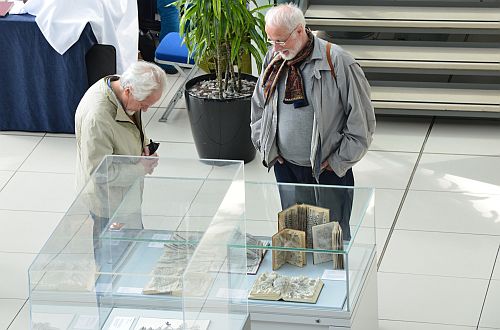
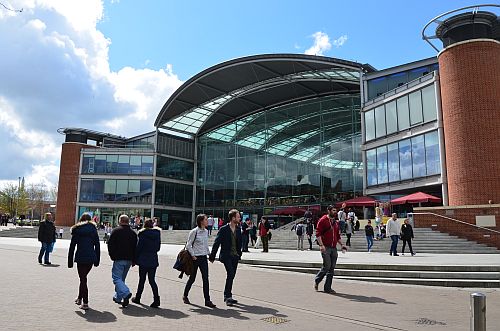
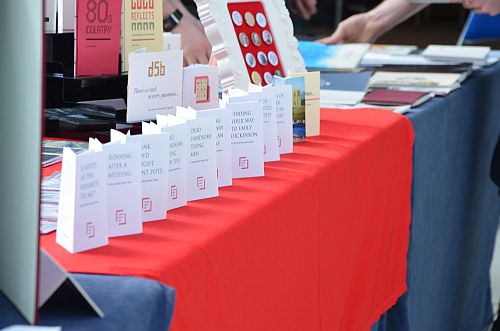
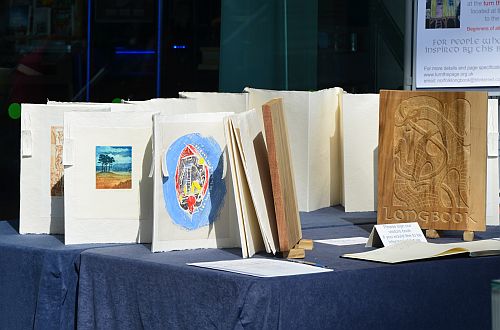
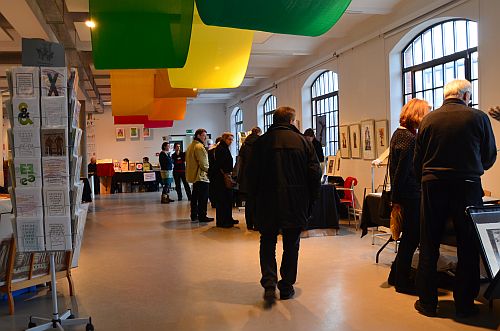
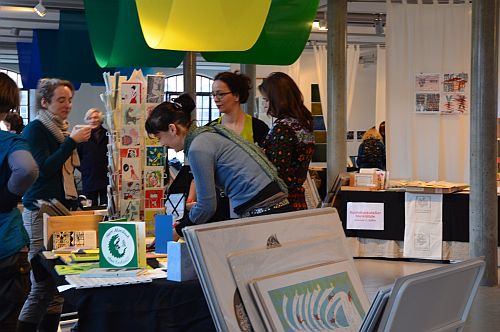
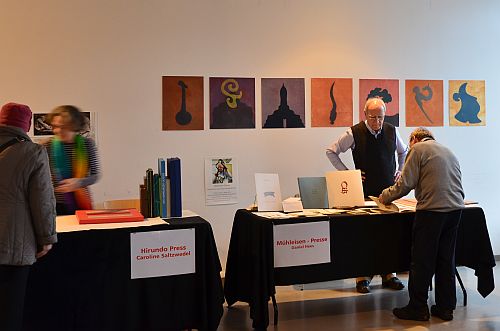
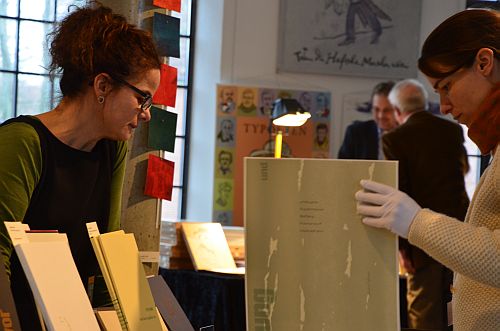
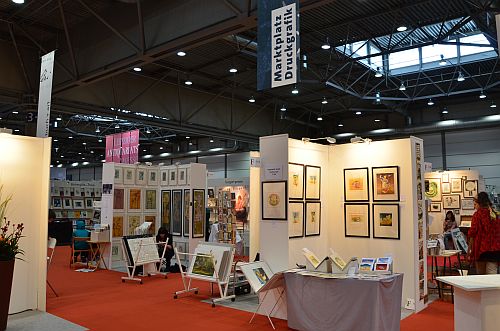
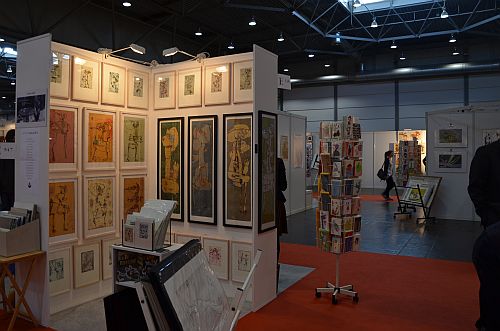
„Marktplatz Druckgrafik“ (Marketplace for Artistic Printing) is a new and unique venue for all printmaker artists and bookartists at Leipzig Bookfair. It is a special area within „buch + art“ (book + art) in hall 3 put up for the first time in 2012.
leipzig-2014-bookandart-DSE_1800

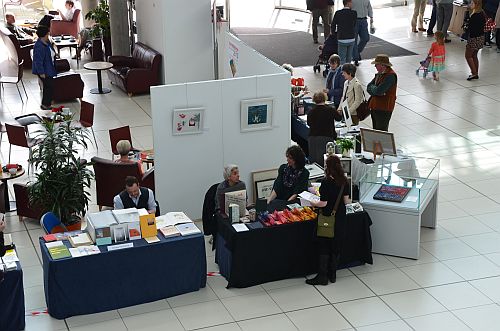
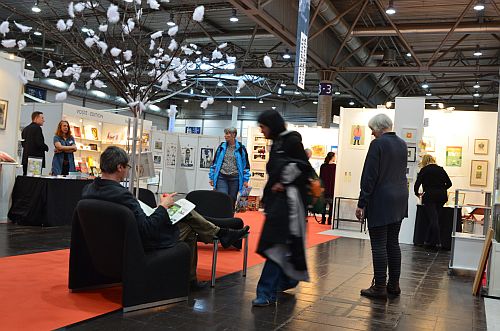
The „buch + art“ area traditionally housed stalls from artists, artistic or bibliophile publishers, universities and schools of arts and design plus stalls of museums and institutions related to printmaking and bookbinding. The whole area is set up nicely with flower arrangements and places where people can sit down and rest.
leipzig-2014-seat-DSE_1845

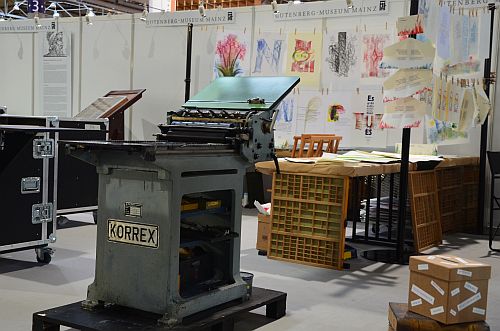
Various printmaking museums, such as the Museum für Druckkunst in Leipzig and the Gutenberg-Museum in Mainz, bring in some of their machinery and visitors can watch or even have a go at printing be it letterpress or lithography.
leipzig-2014-mainzmuseum-DSE_1888
Gutenberg-Museum, Mainz

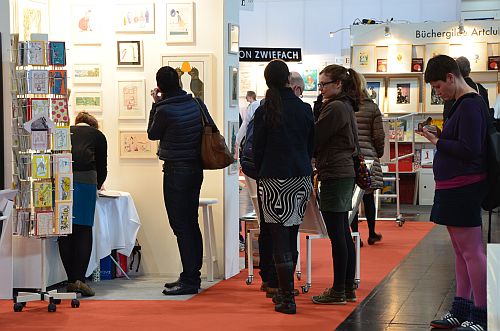
Within „Marktplatz Druckgrafik“ artist have more choices as for stall sizes. Apart from the standard stall sizes (starting from 4 square meters) artists can opt for a special artists stall with is smaller in size and costs. It is 2 square meters, a triangular shape and offers two walls that can be decorated according to the individual artist’s needs and preferences. Tables or shelves can be put up as well.
leipzig-2014-fair-DSE_1764

In 2011 members of Leipzig based artists group AUGEN:FALTER met up with the team of Leipzig bookfair to discuss the possibilities of a special scheme for artists to exhibit at the fair with lower costs. They came up with those specifically designed wedge shaped stalls. The scheme works out well as the steadily growing number of exhibitors in this area shows.
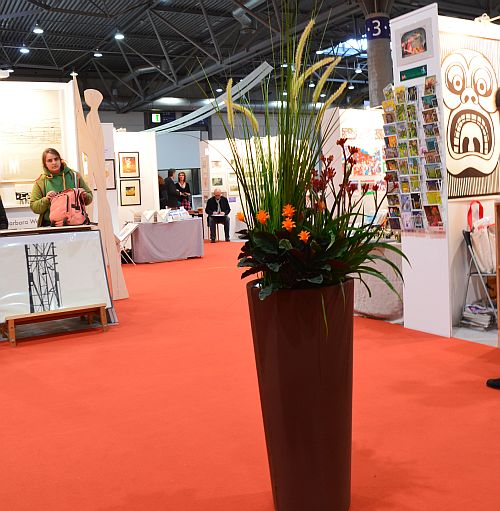
leipzig-2014-flowerpot-DSE_1850

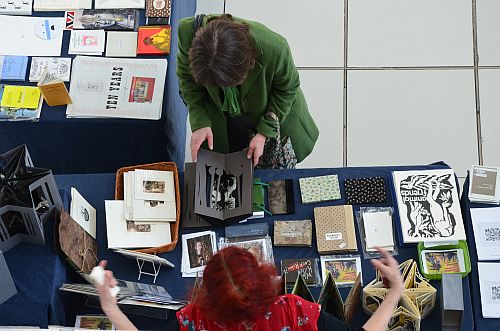
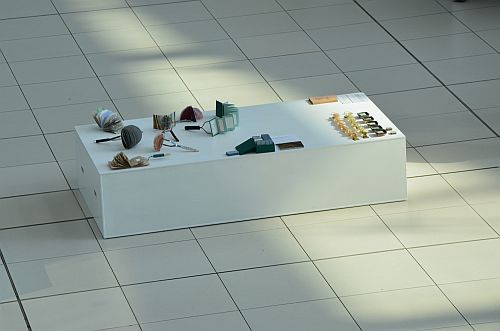
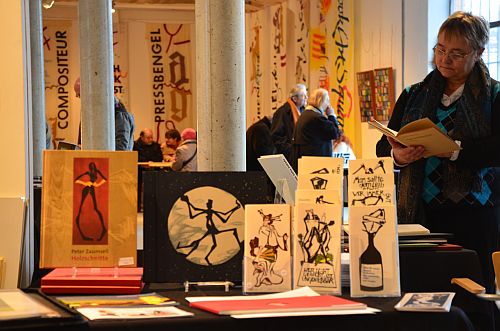
With the multitude of artistic stalls and styles, with prints and books of all sorts a very unique atmosphere of the printmaking arts is established in this area. There are prints in all sizes – from postcard to poster – and all techniques – from woodcut to intaglio. There are books of all sorts as well, from tiny booklets to large volumes.
leipzig-2014-utconf-DSE_1737

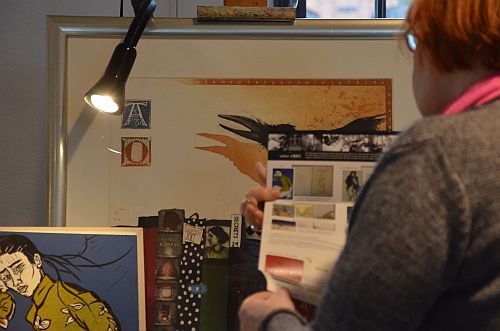
But there is even more to „Marktplatz Druckgrafik“ than those specific stalls and the stunning artistic flair they create. In 2013 there was for the first time the call for entries for an award for young printmaking artists. Every year four young artists will be awarded. This years winners were: Anna Andropova, Jeong Hwa Min, Hyewon Jang and Karla Neumeyer Orlando. With the award winners are given a stall of their own to put their art work on show at the current bookfair. There is also an extra brochure with small portfolios of artists exhibiting at „Marktplatz Druckgrafik“.

Leipzig-2014-brochure-DSE_2049
Brochure with artists‘ portfolios

leipzig-2014-poster--DSE_1833
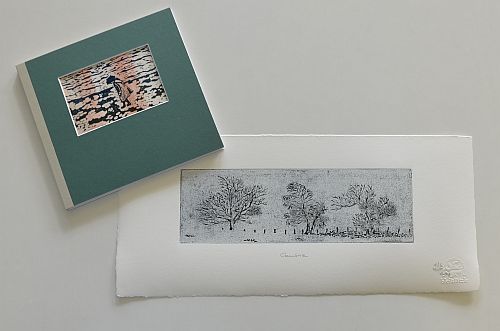
Poster printed by edition carpe plumbum, Leipzig

A well established and important part of Leipzig Bookfair is an event called „Leipzig liest“ (Leipzig is reading). A great number of readings are being held in the fair during fair times and all around the city of Leipzig in the evenings. Just round the corner of „Marktplatz Druckgrafik“ is the special area for readings by „buch + art“ exhibitors from hall 3. So every exhibitor is given opportunity to read to the public from his own books.
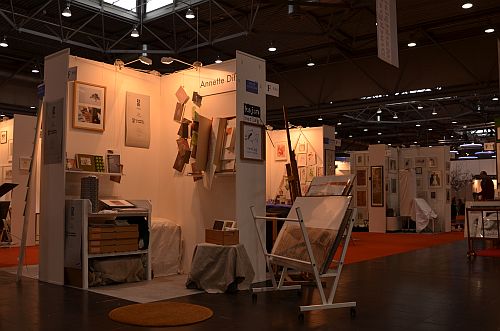
leipzig-2014-F530-DSE_1823

And once the fair closes for the evening there is the humming city of Leipzig with his pubs and restaurants, with readings in all sorts of places – with a cultural life rich as can be.

Contact: Grafiknetzwerk


Leipzig Book Fair 2014: March 13 – 16

Leipzig-2008-signetstairs-DSCN7290

The city’s history has been tightly connected with book production, book trade and the book in general for a very long time. There has been a Book Fair in Leipzig as far back as the 15th century. Trading books in the old times was done by exchanging printed sheets. With there being so many kingdoms in Europe, each of which used its own currency and created its own customs regulations, it was easier to pay for printed matter with printed matter rather than with money.

Until the early 19th century during Book Fair times the city would be buzzing with people and carriages. Every house in town would provide accomodation for business partners from wherever far afield they came. Shops, cellars, vaults and basements would be cleared to be stuffed with books and printed sheets, everybody would be busy trading and negotiating.

Leipzig-gutenbergpath-DSE_0495

Sabine Knopf and Volker Titel have published a book that guides the visitor around the city tracing the remains of Leipzig’s long historical connections with books. Also in this publication are places where time plus the bombing raids of WW2 raids have destroyed all there once was of large publishing houses, printing offices or the homes of great publishers or other famous people associated with books. „Der Leipziger Gutenbergweg“ (The Leipzig Gutenberg Trial) published in 2001 through Sax-Verlag Beucha.

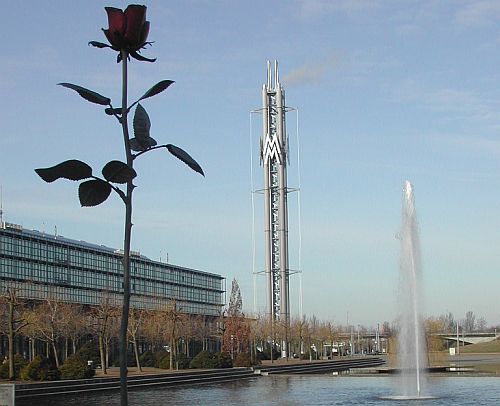
Leipzig-2008-rose-DSCN7289

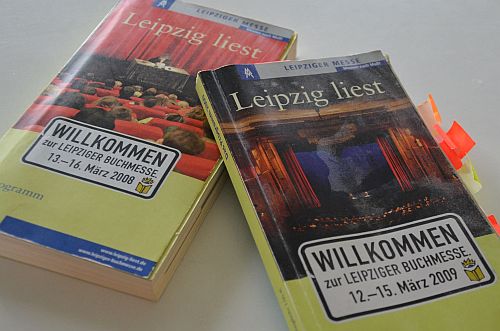
In former times there were fair Spring and Autumn Book Fairs. Nowadays Leipzig Book Fair is a 4 day event occurring in mid March. There is a special program of events that runs concurrently with the fair. Visitors can choose from a great variety of public readings and other types of events. Many of them are located in very special venues around that vibrant city, for example, et the wonderful Leipzig Zoo or a breathtaking Art Deco public swimming pool. Each year a special brochure lists all events concurrent with the fair – more

Leipzig-liest-brochures-DSC_0864

Within the Book Fair itself, there is a special area dedicated to all that relates to book arts: „buch + art“. In 2012 a new feature has been added called „Marktplatz Druckgrafik“ (Marketplace for Artists‘ Prints). This is the venue where printmakers and book artists put their artwork on show and offer it for sale – a haven for collectors, curators and every individual interested in artistic printing and artist’s books. And there is an award for young emerging printer-artists: more
I shall have my own wee little stall this year within this „Marktplatz Druckgrafik“ section and I’ll have my newest book on show. There’ll be updates on this blogpost as soon as the stall numbers come out. In the meantime, if you are inerested in book arts or artist’s books there is considerable reading you might want to do, some of which you can even subscribe to. I am including information on further reading, together with the contact links here on this blogpost:
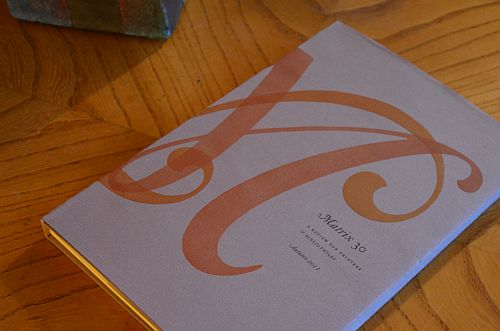
Leipzig-matrix-DSE_0502

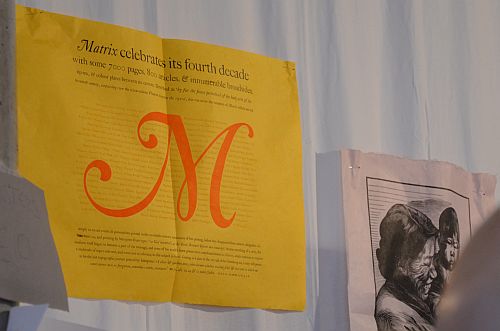
Matrix is a letterpress printed yearbook on themes pertaining to contemporary Fine Press Printing and Book Arts. It is published once a year through Whittington Press (UK), run by Rosalind and John Randle. The next issue is due to be out around April/Mai 2014, and will be No. 32. more

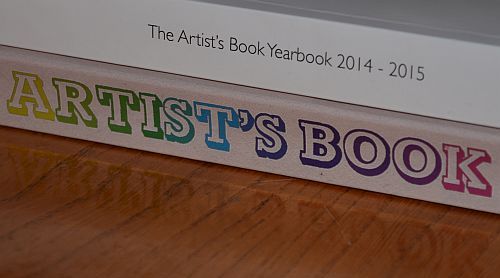
Leipzig-ABYB-DSE_0507

ABYB – Artist’s Book Year Book is published by Impact Press, Bristol (UK) and edited by Sarah Bodman. The most recent issue is 2014-2015. more

Leipzig-bluenotebook-DSE_0510

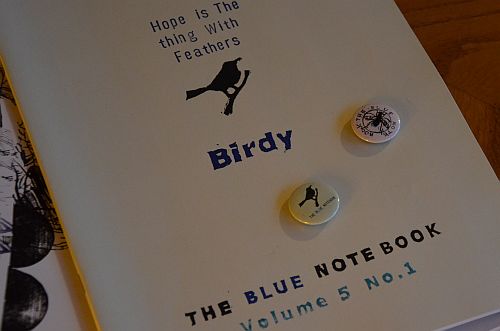
The Blue Note Book is a journal for artist’s books, edited by Sarah Bodman. Each volume comes in two sections: more

The Book Arts Newsletter (BAN) is an online publication and may be downloaded. It is maintained on a regular basis by Sarah Bodman. The next BAN will be out in February 2014 – get your copy here.

You can find many book arts related publications at the website of UWE, Bristol (UK):
http://www.bookarts.uwe.ac.uk/bookpub.htm


Leipzig-fpba-DSE_0500

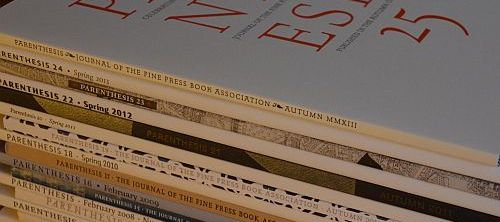
Parenthesis is the publication of the Fine Press Book Association (FPBA). It is out twice a year in spring and autumn and is distributed to all members. With each volume there is a standard and a luxury edition.  more

Leipzig-codex-DSE_0505

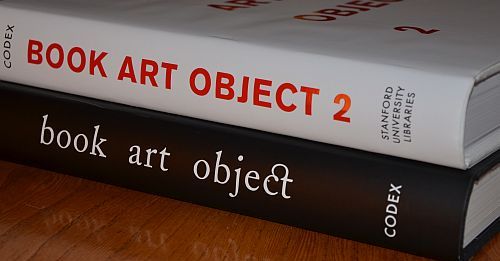
Book Art Object & Book Art Object 2 is published by the Codex Foundation, Berkley (US), edited by David Jury and Peter Rutledge Koch. more

Leipzig-draufsichten-DSE_0512

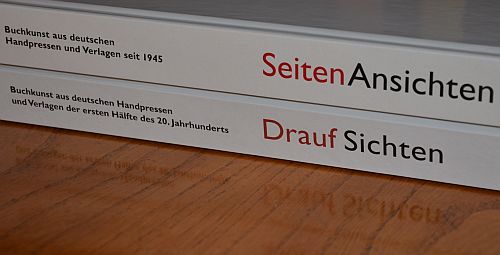
Draufsichten + SeitenAnsichten – Buchkunst aus deutschen Handpressen und Verlagen, Germanisches Nationalmuseum (book arts by German Fine Press Printers, Germanic National Museum, Nuremberg). more

Leipzig-2014-sticker-DSE_0382

BREAKING NEWS: hall 3 stall no. F530
Be inspired:
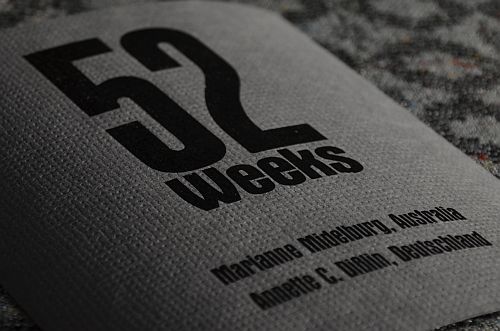
52-weeks-sneak-DSC_1362

As for the new book there is a press release (in German) now online at the fair’s press support desk

Cumbria – an artist’s book

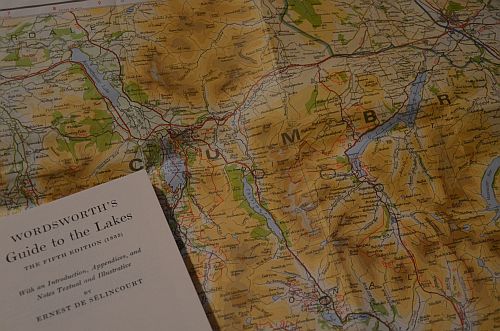
Cumbria-wordsworth-DSD_9468

When on holidays in Scotland some years ago we went into an antiquarian bookshop where we found „The British Encyclopedia In10 Volumes Illustrated“. It was ever so cheap – for the simple reason that volumes 7 to 10 were missing. Being book lovers we couldn’t resist bying it anyway. It had been published back in 1933. Vol 3 said „CHI-DUN“, which meant China-Dunstan(St.) and we find „CUM’BRIA“ on p 360. It reads:

„An ancient British principality, comprising besides part of Cumberland the Scottish districts Galloway, Kyle Carrick, Cunningham, and Strathclyde its capital being Alchuyd or Dunbarton. It was possibly at one time the chief seat of the power of Arthur and in the sixth century was an important and powerful kingdom …The name still survives in „Cumberland“.

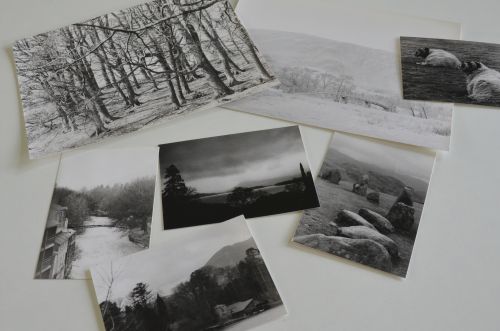
cumbria-bw-fotos-DSD_9150

Now „CUM’BERLAND“ we find on the previous page 359:

„The extreme north-western county of England … There is great variety of surface in different parts. Two ranges of lofty mountains may be traced – one towards the north to which belongs the ridge called Crossfell (2892 feet); and the other to the south-west of which the highest peak is Skiddaw (3053 feet). … The two largest rivers are the Eden and the Derwent. The county embraces part of the „Lake Country“ of England. The largest lakes are Derwentwater, Bassenthwait, Loweswater, Crummock, Buttermere, Ennerdale, Wastwater, Thirlmere and part of Ullswater.
Cumberland is rich in minerals, including lead, gypsum, zinc, and especially coal and rich hematite iron-ore. In the western division of the county there was a great many blast-furnaces, and works for the manufacture of steel and finished iron. The principal crops raised are oats, barley, wheat and turnips, but the bulk of the enclosed lands is sown in clover and grass. The rearing of cattle and sheep and dairy-farming are engaged in to a considerable extent.
Carlisle is the county town, the other principal towns are the seaports Whitehaven, Workington, and Maryport; and the inland towns Penrith, Cockermouth and Keswick.

cumbria-yha-map-DSD_9162

I visited Cumbria back in 1985. It was not spring in the sense that the trees had not yet grown their leaves. There was still a sense of winter as snow was covering the summits of the mountains. It was end of March, I was sleeping in Youth Hostels and some of them were still in winter mode with reduced opening hours. I had decided I wanted to see counties I had not been to so far and since I had only been to Sussex, Essex, Oxfordshire and Berkshire there was a lot more to see than I had time to travel going on what was called a 4-week BritRail ticket.

cumbria-castlerigg-DSD_9152

After one week in Cornwall I was heading north to the lakes, going by train from Falmouth to Penrith, only just so catching the last bus of the day that would take me to Derwentwater Youth Hostel. A few days later I moved on into Keswick Youth Hostel. I have still got the old YHA brochure describing all the hostels in England and Wales and as to Keswick hostel it says:
„Former hotel, near centre of busy and popular lakeland resort at the northern end of Derwentwater. On river Greta overlooking Fitzpark.

cumbria-keswik-host-DSD_9153
View from the window at Keswick Youth Hostel

And my diary tells of the murmur of the river running past the walls of the hostel, then swollen from some late winter rain and the melting snow on the mountains. And even though I missed out on noting it down I still remember vividly that they were selling homemade flapjacks in their shop which were absolutely delicious.
On one of my last days down in Cornwall I had been visiting Trelissick Gardens and bought a copy of William Wordsworth’s „Guide To The Lakes“ in their shop.

cumbria-booktitles-DSD_5853

cumbria-books-DSD_5848

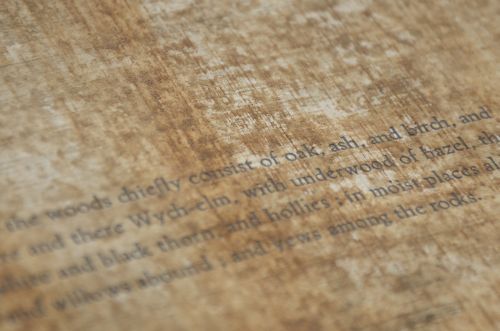
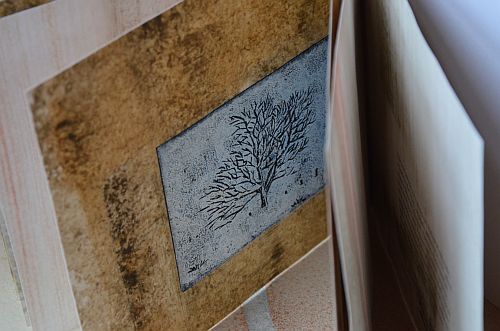
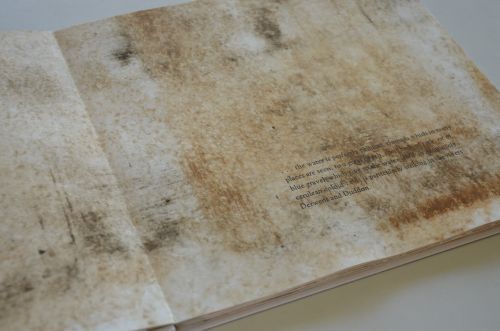
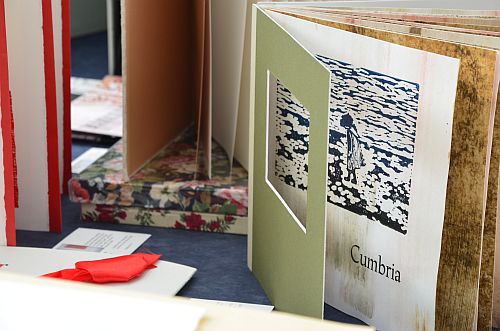
The idea I had in mind when designing my artist’s book „Cumbria“ was that it should be like a walk out somewhere not far from Keswick and Derwentwater. The images are woodcuts showing places I went past when I was walking some of the paths there. The text passages are taken from Wordsworth’s guide, the lines being sprinkeled in between the images like some text passages you might have read years ago will all of a sudden spring to your mind while you walk somewhere in the woods or over meadows taking in the scenery, the sounds and the scents.

cumbria-text-DSD_9139

cumbria-d-DSD_5745

cumbria-page-DSD_9127

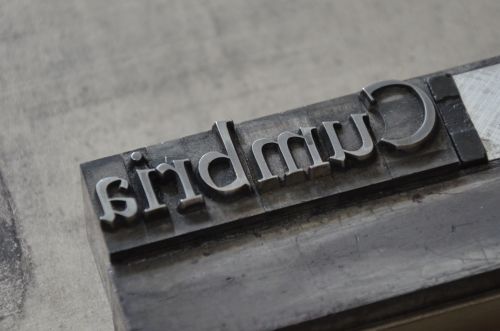
The sheets for the book have been painted prior to printing with specifically made colours using soil pigments. The text is hand set from metal type, the fount used is Trajanus. The book covers are made from passepartout board, the woodcuts are rubbed off by hand, the text is printed on a cylinder proofing press (Grafix).

cumbria-metal-type-DSD_5770

The book is an edition of 6 signed and numbered copies, printed in early 2013. Copy No. 1 is the special edition and it comes with a separate woodcut print by the same title „Cumbria“, copy No. 1 as well. It is, in fact, one of the prints from the book, done separately on deckle-edge paper – in an edition of 6 just like the book –  to be framed and hung up to the wall.

cumbria-spec-ed-DSD_9433

Cumbria – special edition of the artist’s book with print.


turn the page 2013 in Norwich

ttp-2013-04-parvenupress-DSD_6187
Parvenu Press

Norwich has been a city with a strong and inventive connection to books, writing and literature for a very long time and still is. Its literary past has developed into a great number of institutions and events related to literature, which in 2012, won the city the status of England’s first UNESCO City of Literature.

ttp-2013-01-forum-DSD_6233

ttp-2013-03-forum-DSD_6182

As far back as 1395 Julian of Norwich became the first woman to write a book in English. During times of war and plague her writings were telling of love and hope. In 1970 the first Creative Writing Master of Arts degree in the UK was founded at University of East Anglia with Ian McEwan being its first graduate. The vibrant literary community is constantly keeping in touch with contemporary needs and in 2006 Norwich as the foremost city in the UK joined the International Cities of Refuge Network, a worldwide net to give support to threatened writers and stand up for free speech.

ttp-2013-08-forum-DSD_6234

Apart from Ian McEwan there are a number of great names connected to Norwich and its literary life. W G Sebald founded the British Centre for Literary Translation, humorist Stephen Fry calls Norwich his home. And there are many more.

ttp-2013-00-forum-DSD_6282
The Forum

In the late 90ies the then public library was badly damaged during a fire. It was replaced by the Norfolk and Norwich Millenium Library, which quickly developed into the most-visited public library in the UK and has been so for the past 5 years. The Forum is right in the city centre and for two days in early May this year its entrance hall turned into a book art wonderland showcasing „books but not as you know them“.

ttp-2013-hazardpress-DSD_6227
Hazard Press

All book arts can give was present: altered books and zines, limited editions, typographic and illustrated artwork, sculptural books and installations, virtual and interactive works. With spring at its best and the sun shining brightly from a blue sky, the cherry trees were in full bloom around Norwich Castle and elsewhere in the city – just everybody had a smile on their face.

ttp-2013-norwich-castle-DSD_6314

Alongside the fair the Norfolk Longbook was presented to the public. It is an ongoing community project with artists and authors contributing works related to or inspired by Norfolk. It is to become the longest book in Norfolk. You can get involved by sending in Norfolk inspired work or join one of the special workshops. Check for dates and details with their website.

ttp2013-norfolk-longbook-cl-DSD_6225

A vital part of the vibrant literary life here is the Writers‘ Centre in Norwich. It not only works locally but also nationally and internationally with workshops, courses, networking and competitions. One of the events they are running currently is „Summer Reads“ where they made their choice of 6 books to read during the summer offering readings and events related to every one of the 6 books. This year they have teamed up with ‚turn the page atrists‘ book fair‘ and have send out a call to all artists to get inspired and creating their response to one or all of this year’s Summer Reads‘ books. More about Summer Reads at
www.summerreads.org.uk

ttp-2013-bleikloetzle-DSD_6220

Find more on the fair and the longbook project on their website: www.turnthepage.org.uk

and find ‚turn the page‘ on facebook too

ttp-2013-09-norwich-DSD_6419
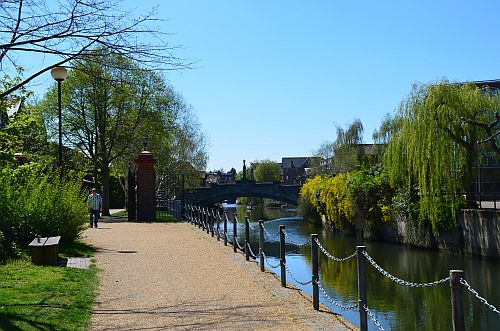
Riverside Walk

We had a wonderful time in a wonderful place in a wonderful city with a marvellous weather. A huge thankyou to all of the team at ttp!
(No idea where you got that special sunshine taskforce from but they were really good at it.)


John Rylands Library Manchester: An Inventory of Al-Mutanabbi Street


00-ma-john-rylands-histread-DSD_7108

! June 7th talk+reading by Beau Beausoleil at the library – details at the end of this blog!

We found ourselves a lovely B&B right in the middle of fields with horses grazing in the peace and quiet of the countryside on the Cheshire-Staffordshire border. After nearly two weeks of gorgeous spring weather with sun and blue sky wherever we went – be it Norwich or Chester – during this early May we watched a colourful sunset telling us the weather was about to change. We woke up to a cold morning with a rainy sky on May 9th.

05-ma-johnrylands-exhibit-DSD_7113

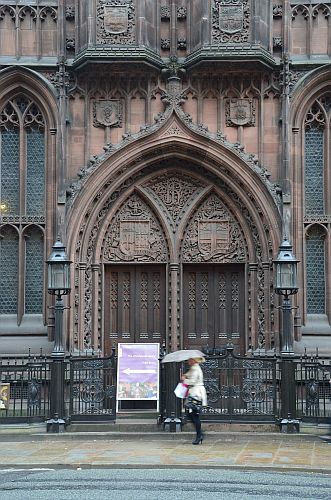
We could have left the car in Crewe and taken the train into Manchester but tried to find a Park&Ride in some of the outskirts of the city. We left the car in Trafford (the P&R there did only exist in the memory of our SatNav but we found a place for the car some yards down the road) and took the tram from Cornbrook into Manchester Victoria Station where free shuttle busses take you to a stop just opposite John Rylands Library. It was still raining but the building was none the less impressive.

01-ma-johnrylands-front-DSD_7195

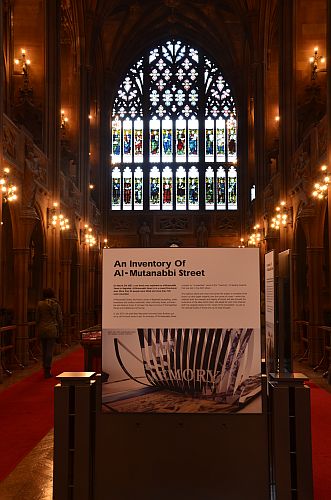
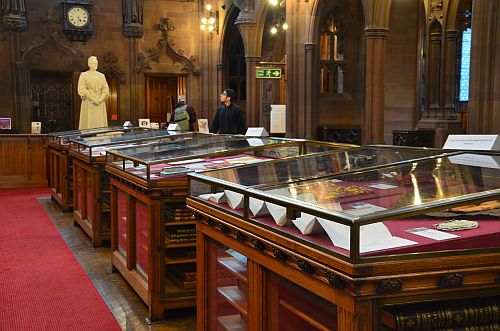
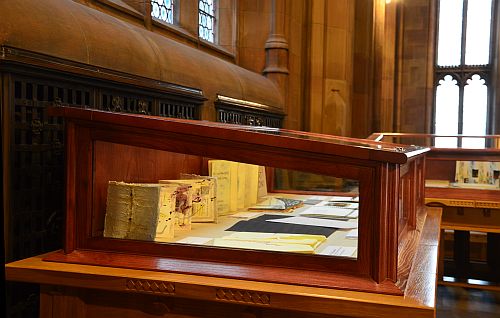
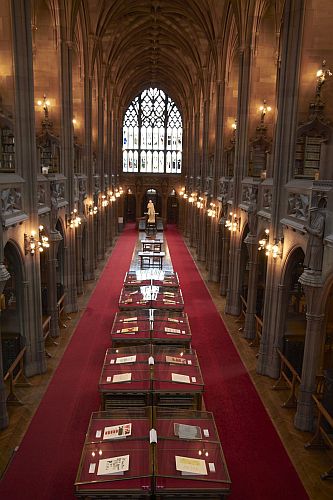
The exhibition of „An Inventory of Al-Mutanabbi Street“ spreads out on three floors with the major part in the Historic Reading Room, one display case on the ground floor café and a number of them in the little cloister.

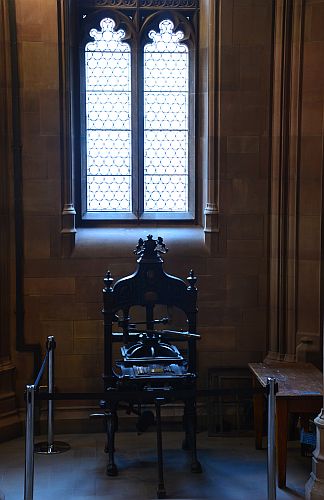
06-ma-johnrylands-press-DSD_7165

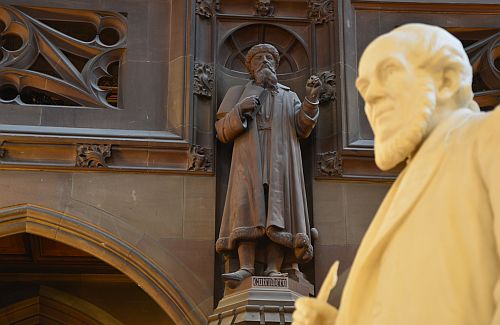
Entering the Historic Reading room from the far end makes you face it almost in its entire length with the stained glass window in the back far above your head. The stone masonry in the cathedral-like room is breathtaking. All the show cases are being watched by the statues of the famous of the past. Homer, Skakespeare, Newton – representing the cultural heritage and pursuit of knowledge ever since we learned to speak and write, thus literally reminding of what this project is about: Al-Mutanabbi Street Starts Here.

02-ma-johnrylands-gutenberg-DSD_7123

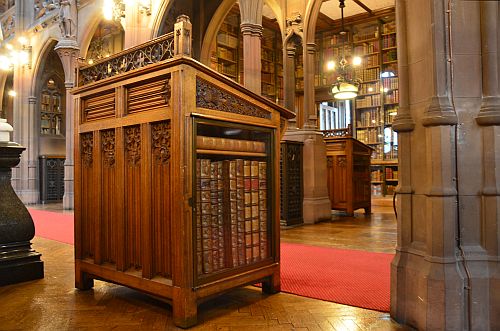
Stepping into the room and walking along makes you realise that his is not a cathedral but a library. On either side there are a great number of recesses which either are furnished with a table and chairs or with large card index boxes. The walls of the recesses are covered from floor to ceiling with wooden shelves filled with books. Students have their laptops out on the tables working. The very specific quietness of a library in which work is being done sweeps gently through the room.

03-ma-johnrylands-library-DSD_7115

With respect to the copyright of the exhibiting colleagues you will not find any close ups of artist’s books on this blog. Of course you will have a much more intense experience of the books with being in the room and seeing them yourself. This blog is to say: It is more than worth while to go and see this exhibtion in this very special and extraordinary place.

07-ma-johnrylands-cloister-DSD_7189

For all who cannot come to Manchester: you can either try to find a venue nearer to where you live on one of the projects‘ websites or: there is an online catalogue of the books in the project at the galleries pages of the CFPR in Bristol: http://www.bookarts.uwe.ac.uk/mutanmain12.htm

04-ma-johnrylands-books-DSD_7126

And when you’ve seen it all and taken in and are about to leave, before you step out onto the roads in Manchester again in whatever weather awaits you: when still in the library’s shop and facing the door, turn right and look for the donation box with Mrs Rylands having tea with the dragon. Go there, put in a coin or two and watch – it’ll make your day, if the library and the exhibition have not done so already.

The exhibition will be on until July 29th.
The library is open
Mondays 12 noon – 5pm
Tuesdays – Saturdays 10am – 5pm
Sundays 12noon – 5pm
Last entry 4.30pm daily

08-ma-johnrylands-sign-DSD_7092

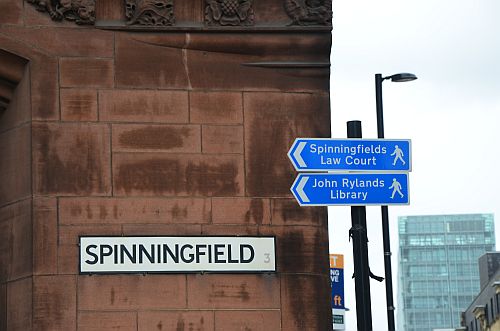
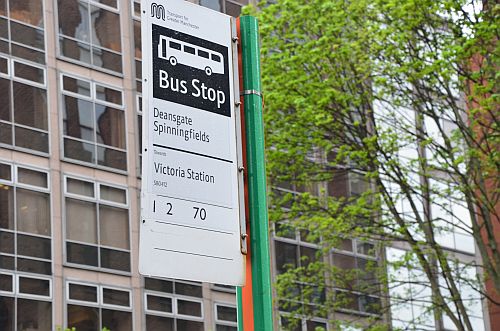
This is where you want the free shuttle bus to take you to: Deansgate, Spinningfields, John Rylands Library, it is the green line No 2 that takes you there from Victoria station.

10-ma-johnrylands-bus-DSD_7200

More information on the library’s website:
http://www.library.manchester.ac.uk/rylands/exhibitions/

Safe the date: June 7th from 6-8pm
Beau Beausoleil, the founder of the al-Mutanabbi-Street coalition, will be at John Rylands Library speaking about the project and reading from the award winning al-Mutanabbi Street anthology. He’ll be joined by Sarah Irving, a blogger of the Middle East and North Africa.
If you are anywhere near: don’t miss it!

The projects‘ website with a list of all upcoming venues of An Inventory of Al-Mutanabbi Street:
http://www.al-mutanabbistreetstartshere-boston.com/exhibitions.html

A German/English website of the project:
http://www.al-mutanabbi-street.bleikloetzle.de/html/kontakt_links.html

The exhibition has moved to a further venue in Newcastle (UK) and opened August 5th. Find a blog with details here: http://theresaeaston.wordpress.com/2013/08/05/an-inventory-of-al-mutanabbi-street-2/


Turn The Page Norwich 3rd + 4th May

cumbria-d-DSD_5745

It was a cold and wet Easter back in 1985 when I was on a 4-week BritRail tour around counties in England. I had been on a long walk around Beverley and by the time I got back I was soaked. When I got to the friary I found a lovely fire burning in the fireplace, the room warm and filled with a joyful group of cyclists who had all got soaked just like me. Half of the chairs were colourfully dressed in wet clothes and put in front of the open fire. The remaining chairs were occupied by people with mugs talking happily.

85-10-7-kingslynn-d-

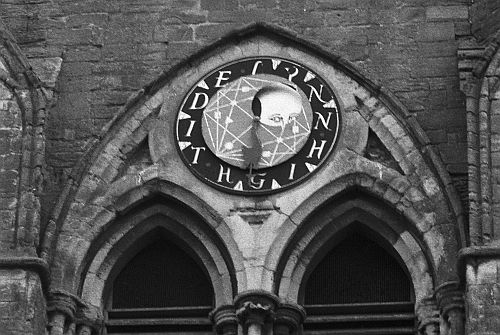
While taking a picture of a peculiar clock in Kings Lynn a passer-by asked me whether I knew anything about this clock. And since I denied he explained it to me. It was an old but sophisticated device to tell the time of the tide. Apparently it was stunningly precise.

85-11-3-saffronwalden-d-

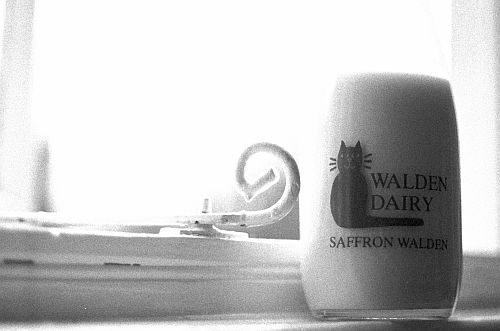
I have met people on trains, in towns and youth hostels. I was taken to a gaslamp lit pub which was said to be the last of its kind. The images and stories I brought home are enough to fill a good number of books. „Cumbria“ will be the first of them. It’ll come with woodcuts showing places around Keswick and Derwent Water.

85-11-18-colchester-d-

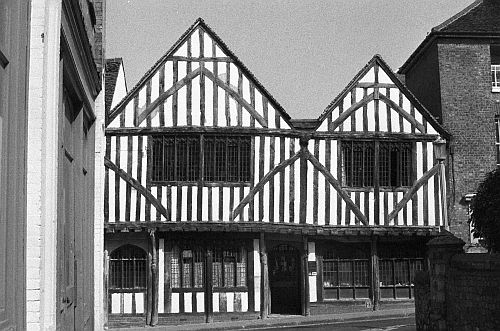
The new book will be out at this year’s Turn The Page on 3rd and 4th May. The fair is held in the glass atrium of the Forum in the city centre of Norwich and will be open 10 am-6pm both days. Find out more about the event and all that goes with it here: www.turnthepage.org.uk

(You can also find Turn The Page on facebook)


Imagine.

al-mut-2011-manchester-johnrylandslibrary

John Rylands Library, University of Manchester (image credits: Katie Donlon)

Let’s imagine there was neither written nor printed word (as the printed is just a shortcut to the written). The only way to keep information, experiences or thoughts and ideas was to memorize them. And the only way to pass them over to others was to tell them, leaving them to memorize what they just have heard. Such was man’s situation before written signs like alphabets had been invented.

In a community like this the death of a knowing and experienced person is equivalent to a library burning down. All memories are lost: experiences, history, ideas, knowledge about wildlife, edible plants or treating illnesses, songs, myths, fairy tales – a whole cultural heritage and the basis of gaining further knowledge by building up upon what has been learned over generations will be gone.

al-mutanabbi-lyricard-DSC_7789

Normally, we assume that with the invention of the written word all knowledge is conserved and kept for following generations.
It is not. The written and printed word has been hunted ever since it came into man’s hands.
Libraries get burned – like only days ago in Mali – or over and over again in the past.
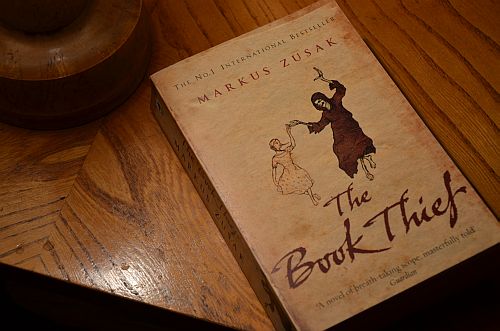
Books get burned – like in the 1930ies during the Nazi reign in Germany, of which Markus Zusak told us so brilliantly in his „Book Thief“ novel – or over and over again in the past.
A street of booksellers gets bombed – as happenend on March 5th in 2007 in the centre of Baghdad.

bookthief-zusak-DSC_7122

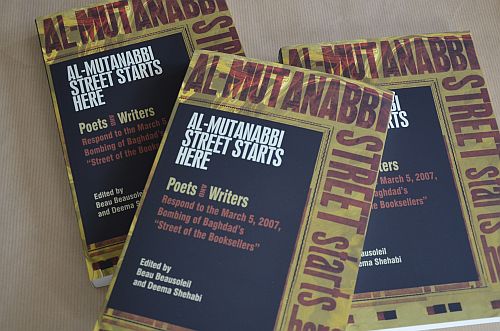
Baghdad’s al-Mutanabbi Street has been the intellectual heart, the centre of culture and thought and book trading for centuries. It got destroyed by a car bomb in 2007, it was rebuilt and bulldozered again.

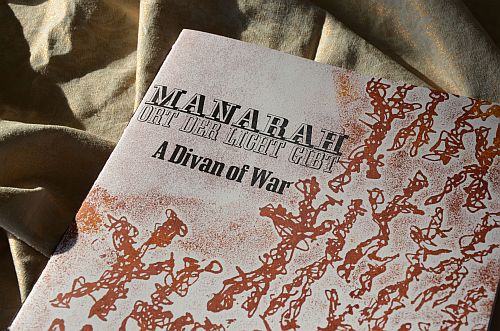
manarah-war-poem-DSD_4291
When books get burned or bombed it is first of all for ideological reasons be they religious or political. With reading a book a person can gain knowledge totally by him- or herself. They do not need the help or assistance of anybody – they just need to be able to read and they need to have a book. And it is these two aspects weak and unconvincing rulers will fight first:
They will keep the young from going to school and learn to read, and they will keep those who already can read from reading by destroying their source of information or by changing the alphabets thus following generations will not be able to read the writings of the past.

manarah-war-title-DSC_5464

By reading we learn about history, our own and that of others, about ideas and philosophies, about other places, other people, about war and peace, love and hate, about music and poetry, about literature and science, politics and religion – we learn that the world can be different from what we have so far known.
Any force that tries to keep people from learning and gaining knowledge is preventing them to be able to make up their minds by themselves. It is an act of manipulation.

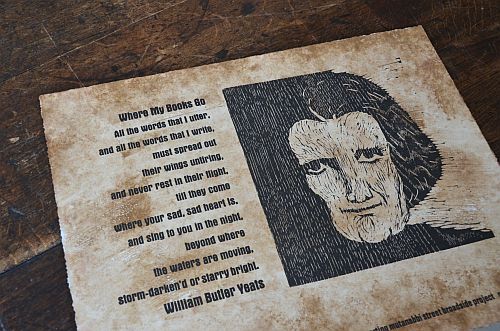
al-mutanabbi-broadside-DSC_7606

One way to oppose against the burning of books is to make new books.
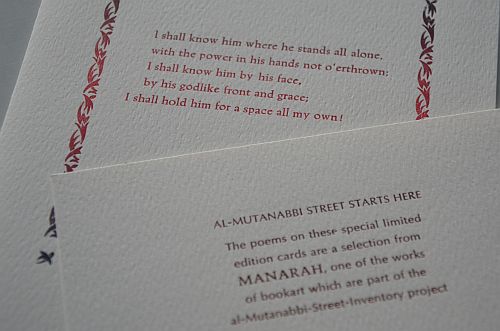
On 6th February 2013 the first complete exhibition of „An Inventory of Al-Mutanabbi Street“ will open at John Rylands Library at the University of Manchester, UK. 260 book artists from all over the world have been making new books commemorating the car bombing of al-Mutanabbi street in 2007 – standing up against the deliberate destruction of books and the cultural heritage they preserve.

al-mutanabbi-anthology-DSD_2454

Imagine: al-Mutanabbi street starts here. In Timbuktu. In Baghdad. In a girls‘ school that is about to be closed for ideological reasons. Everywhere on this planet where people are kept from learning and reading on account of their own free will.

An Inventory of al-Mutanabbi Street
February 6th to July 29th 2013
John Rylands Library, University of Manchester, UK

More information and further venues on:

An English/German webspace: www.al-mutanabbi-street.bleikloetzle.de

The project’s webspace: www.al-mutanabbistreetstartshere-boston.com

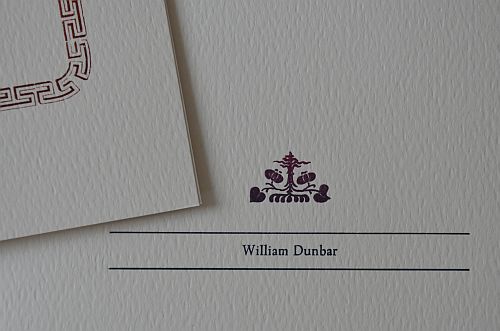
al-mutanabbi-card-dunbar-DSC_7579

8th Book Arts Fair in Hamburg

fair-HH-2013-newfactory-ground-DSD_4351

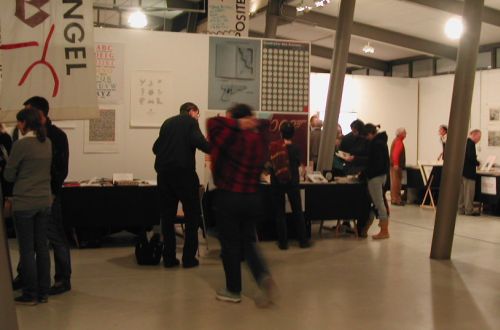
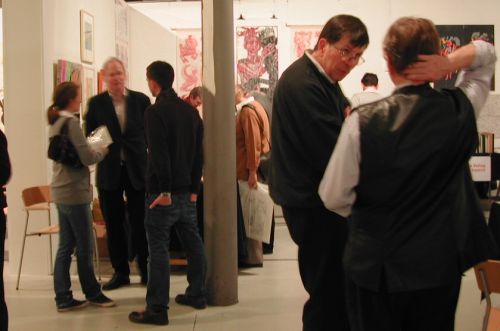
The fair closed on Sunday January 20th around 5 pm. It always amazes me, when a fair closes how quickly books and works and chairs and tables seem to vanish – as if none of them had ever been there leaving the rooms more than empty. They have been there, all of them: wonderful prints, amazing books, dedicated arists, a caring team of organizers and many, many interested visitors. A good lot more than came to the last fair. Some 50 artists had been putting their works on show for two days plus the opening on Friday night.

fair-HH-2013-papermill-DSD_4340

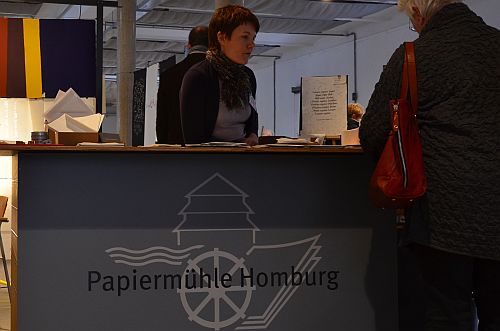
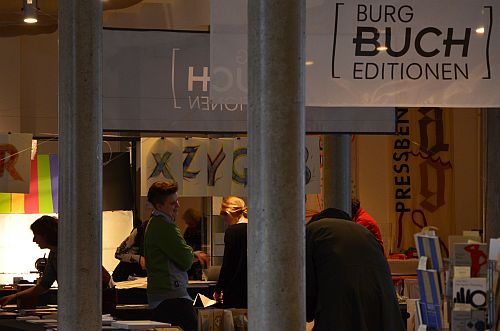
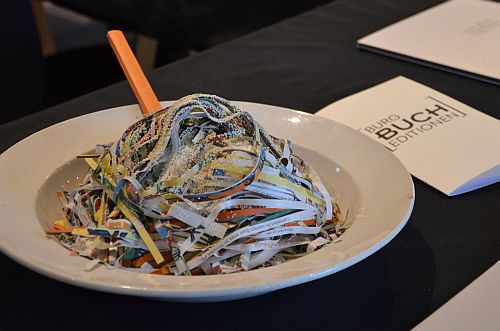
On the ground floor of the New Factory of the Museum der Arbeit in Hamburg Johannes Follmer and his wife welcomed visitors with their marvellous papers demonstrating how the sheets were made traditionally by hand. Students of book arts school Burg Giebichenstein presented their ideas of what a book can look like.

fair-HH-2013-giebich-DSD_4372

fair-HH-2013-pastaplate-DSD_4377

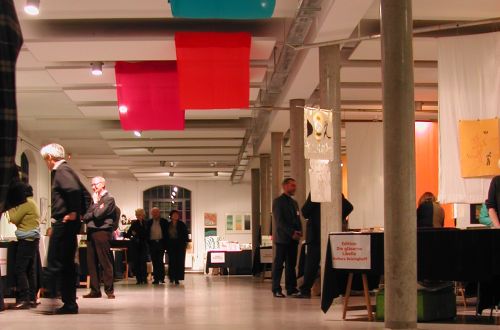
And this is what the first floor of the New Factory looked like.

fair-HH-2013-newfactory-1-DSD_4333

A wide room with large windows and a swinging decoration created a wonderful calm and warm atmoshere – perfectly fine to take one’s time to look at books and prints.

fair-HH-2013-augenfalter-DSD_4370

This is a group of printmaker artists calling themselves „Augenfalter“. Being located in Leipzig they took a cooperation with Leipzig Book Fair called „Marktplatz Druckgrafik“ to built up a special area for printmaker and book artists within the Book Fair’s department ,book+art‘. This new scheme had a fine start up in 2012 and will be running during this year’s Leipzig Book Fair in March for the second time.

fair-HH-2013-augenfalter-DSD_4358

Daniel Hees with his Mühleisenpresse and Caroline Salzwedel with her Hirundo Press came side by side.

fair-HH-2013-hees-DSD_4334

Rosa Gabriel (Erzengelpresse) was presenting her very sophisticated works of book and paper art. She is one out of 260 artists from around the globe that take part in the project „An Inventory of al-Mutanabbi Street“.

fair-HH-2013-gabriel-DSD_4389

A wide variety of prints and books and styles could be found. Visitors got taken in – and willingly took their time to look and discuss and enjoy.

fair-HH-2013-works-DSD_4379

fair.HH-2013-vogelpresse-DSD_4392

As with the works by Vogelpresse (Munic) they did not hesitate to discover a work of book art from the first to the last page.

John and Pat Randle, who are running Nomad Letterpress in Whittington (UK), were having copies of Matrix with them, which they publish roughly once a year with articles on contemporary topics of Fine Press Printing and Book Arts.

fair-HH-2013-matrix-DSD_4383

It was a wonderful fair. Many thanks to all who contributed to it – special thanks to Mr and Mrs Bartkowiak and their dedicated team of BuchDruckKunst e. V.

fair-HH-2013-bbDSD_4368

We are all looking very much forward to meeting again in 2014!
The 9th Book Arts Fair in Hamburg will be held: 18 + 19 January 2014.

See you there!

Artist’s Books in Hamburg: 19 + 20 January 2013

Link

fair-HH-museum-DSCO3524

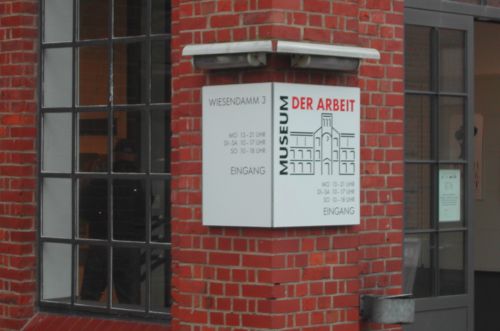
If you’re interested in and love hand printed books and bookarts, then the place to go in January is to North Germany, to the ‘Museum der Arbeit’ in Hamburg-Barmbek.


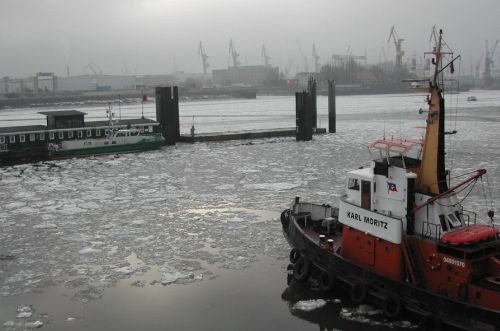
fair-HH-river-DSCN9043

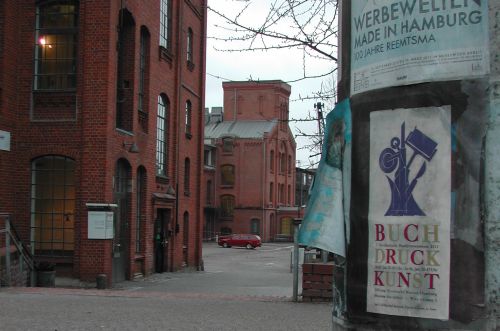
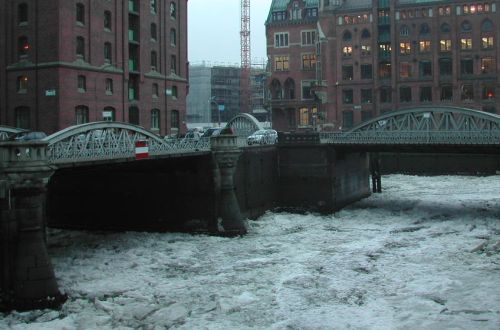
Hamburg is, by itself, an excellent travel destination with all its galleries, museums, historical buildings and public events. In mid January, however, there is a special event for lovers of bookarts: On the 19th and 20th January fifty book artists and printers will gather to display their artwork in the wonderful old redbrick buildings of the former ‚New-York-Hamburger-Gummi-Waaren-Compagnie‘ rubber factory. Founded back in 1871 the factory steadily grew until it was shattered during the WW2 bombing raids. Over the years the remaining sections have been carefully refurbished and are now used as a museum to show the impact 150 years of industrialization has had on the every day life of workers and their families.

fair-HH-poster-DSCO3515

One of the many events held at the museum is the ‚Norddeutsche Handpressenmesse‘. This trade fair brings bookarts to Hamburg–Barmbek, and within walking distance from the Barmbek tube station. With this 2013 fair the schedule changes from a biennial to an annual cycle. From this year on some 50 studios from around the world as well as individual artists will be given the chance to put theirworks on show – and visitors the opportunity to browse them all and buy their favourite books.

fair-HH-2009-DSCN9072

One section of the museum houses, from former times of letterpress printing, equipment which was used in any printing office; namely different types of printing presses, a large stock of metal type and even type casting machines such as Linotype. The experienced and dedicated members of staff know how to work these machines and will demonstrate to visitors how the hard work of letterpress printing was actually done. They will be giving practical demonstrations during the 2 days of the fair. Visitors will have the possibility of not only seeing and holding the finished books, but also watching the different work procedures involved in printing and making a book.

fair-HH-2011-DSCO3509

There will be other events alongside the fair, such as an exhibition of new works by Masters of Bookbinding, Calligraphy and Lithography. Papermaker Johannes Follmer will also demonstrate the art of handmade papermaking. Follmer usually works from his family’s papermill in Triefenstein, which is not far from Heidelberg. Artists can ask him to make paper to order specified for their special printing purpose and even with an individual watermark in every sheet.


One can find all events and a complete list of exhibiting artists and studios at this link: http://www.buchdruckkunst.de


fair-HH-2009-DSCN9073

Click here to find more English language information about the ‘Museum der Arbeit’ in Hamburg-Barmbek:  http://www.museum-der-arbeit.de/Museum/konzept.en.html

fair-HH-museum-DSCO3503

Find the museum’s website here: http://www.museum-der-arbeit.de

fair-HH-winterice-DSCN9059

The fair in 2013 will be open
on Saturday, 19th January from 10 am to 7 pm and
on Sunday, 20th January from 10 am to 5 pm

Information to feed in your GPS:
Museum der Arbeit, Wiesendamm 3, 22305 Hamburg-Barmbek


Where The Red Poppies Dance

When I was a student studying in England in the 1980s I heard about Remembrance Day for the first time. I saw all these people wearing their red poppy flowers pinned to their shirts, jackets or coats. And then I wondered whether they seriously wanted to ‘celebrate’ the horrific First World War that England had been involved in. It took me some time to understand that I had got it quite wrong back then.

When the horrific killing finally came to an end on the 11th November 1918 it left Flanders devastated. Large parts of the countryside had been ploughed over by the massive bombing and the dismembered bodies of thousands of soldiers had gotten mixed with the soil in a way they could not be brought home or even buried in the proper respectful manner. Within days the countryside had turned into a sea of red: millions of red poppies covered these fields of grief and horror. Red poppies are summer flowers; they don’t usually come to bloom in November. On the other hand, a botanist would be able to give a quite unspectacular explanation as to what happened then and why.

However, there’s a bit more behind this. For a very long time the Red Poppy has been seen as a symbol for both Death and Life. People in all their grief, pain and despair, could see the message pinned to the coat or jacket and understand. The still unknown total death toll of WW1 demanded action to be taken for Life and for the living. The Red Poppy became the symbol for Remembrance Day, a day to remember not only all those, who had fought and died, but also those individuals that had survived wounded; who had lost a limb or their sight. The Red Poppy is also a symbol for the families who had lost a father, a brother or a son, and for the many young women who had lost their husbands, many of whom had only been married weeks or months earlier. The Red Poppy reminds us of the tragedies any war can bring. This simple red flower is a warning to always be aware and be prepared to take appropriate and timely action against looming conflicts.

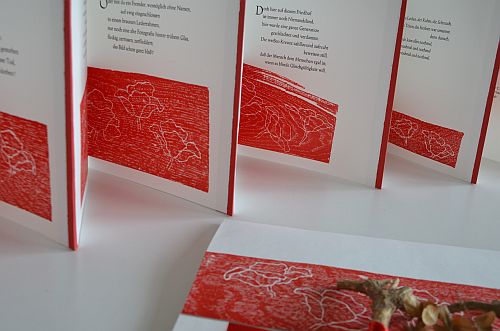
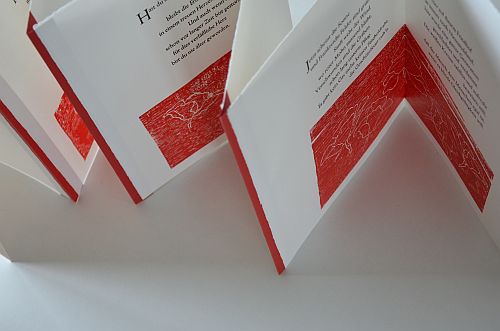
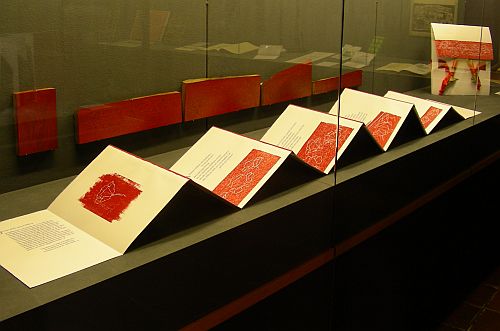
In 2006 I asked Scottish-Australian folksinger and songwriter Eric Bogle if he would give me the permission to translate his song ‚No Man’s Land‘ into German in order to make an artist’s book. He immediately gave me permission. I loved his lyrics and very much enjoyed translating them into German. Then I made 5 woodcuts of Red Poppy flowers dancing in the wind over Flanders. The finished result is a concertina-folding type book; the sheets of the deckle-edge paper are connected with poppy-red folds. The woodcuts are rubbed off by hand and printed poppy-red. I used blocks of oak wood that had cracks and an interesting wood grain, giving a most pleasing texture.

The song text is set by hand from a very old and much used metal type: Trajanus. The book is housed in a portfolio with a clasp made of poppy-red ribbon and Boxwood twigs. Boxwood was very commonly used as a border of graves, symbolizing eternal Life, everlasting true Love and the overcoming of Death. The edition is signed and numbered and limited to 11 copies relating to the particular date and time of the 11th November at 11 o’clock in the morning when the guns finally fell silent.

Find more here: http://www.bleikloetzle-goes-british.de/html/red_poppies.html
including a link to Eric Bogle’s original lyrics and a reference for further reading.